Friday, June 15, 2012

LIZARDS ARE COOLER WHERE IT'S HOT


We have lizards in the Pacific Northwest, but like all other reptile groups, they become more common and diverse as you travel lower in latitude. In the southwestern deserts, lizards often dominate the landscape, if you exclude the ever-present and noisy birds.

Lizards seem among the most heat tolerant of any vertebrates. You walk around in the desert when it's so hot you really shouldn't be out there, and you find lizards running ahead of you across the burning sand. Most of them are long-legged, and they hold their body above the substrate as they move. The really fast Zebra-tailed Lizard (Callisaurus draconoides) can run bipedally, using only its hind legs for a slightly greater speed. They have been clocked at four meters per second, and they seem to blur as they run. As your eyes follow them, you may not see that they stop.

The long legs and toes, especially the hind ones, are what furnish the combination of speed and sand traction that these lizards need to move about. All of their needs are met by high speed: predator escape, prey capture, and quick moves from shade to shade. Try chasing one down. None of the lizards shown here does much climbing except the Lesser Earless Lizard (Holbrookia maculata), which moves around on rock faces or up in low shrubs.

One adaptation shared by all these lizards to avoid the hot desert sand is to contact it as little as possible. One way of doing this is to rest on their heels and flex their toes upward. Perhaps their toes are especially heat-sensitive. And if you keep watch, you'll see that these lizards usually head for shade in the middle of the day. They're not that heat tolerant!

Earless lizards are unique in lacking external ear openings, perhaps an adaptation to keep sand out of the ear. Oddly, the closely related Zebra-tailed Lizard and fringe-toed lizards (Uma) have ear openings, yet they spend even more time on the sand. Maybe earless lizards just like silence!

The heads of the Zebra-tailed and Lesser Earless lizards are somewhat scoop-shaped, widest at the mouth. They push their head into the sand and, by digging with alternate strokes of the legs, bury themselves very quickly to avoid predators or spend the night.

Most of the lizards of the desert eat arthropods, with two rather different modes of foraging for them. The common mode is as a sit-and-wait predator. The lizard remains in one spot and watches around it. If it sees an insect or spider, it runs and grabs it. The Leopard Lizard (Gambelia wislizenii) is large enough to take other lizards as prey.

The other mode is as an active searcher. This characterizes the whiptail lizards of the genus Aspidoscelis (formerly Cnemidophorus). They move slowly along, digging in the soil with alternate front legs, and scare up or unearth their prey. They are just as fast on the go as the other types, though. The striped pattern helps them disappear when they move into dense cover. As in striped snakes, the animal doesn't seem to move when you see only part of it.

One of the lizards shown here, the Desert Iguana (Dipsosaurus dorsalis), is a herbivore. Typically it takes leaves, flowers and fruits of the low shrubs that are common in its arid habitat. Note its blunt head, not so different from the big green iguanas of the tropics.

Check out the southwestern desert in summer, the lizard season, but be sure to bring water!

Dennis Paulson


Wednesday, May 2, 2012

THE RINGED TAIL TALE

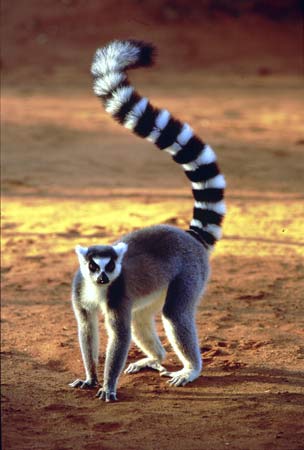
The Ring-tailed Lemur of Madagascar.
At our recent event, Exotic Species Night, visitors of all ages had the opportunity to see, touch, smell, and experience the museum's strangest, most exotic natural history artifacts. One booth in particular received a great deal of attention -- the "Odd Objects and Curious Artifacts" table. This table was a hands-on, touch-everything station with a collection of mystery "stuff" ranging from Mastodon teeth and whale earbones to Pencil Urchin spines and giant Tusk Snails. One object was particularly intriguing to some of our younger visitors -- a long, bushy, black-and-white striped tail. Nearly everyone correctly identified the original owner of the tail as none other than the Madagascan Ring-tailed Lemur. But one particularly inquisitive 4th-grader wasn't convinced.

"But couldn't it also be a raccoon's tail?" she asked. "Raccoons have striped tails too! How do you know it's  not a raccoon tail?" After reassuring her that I personally had seen the lemur before it became tail-less (which truthfully was not all that reassuring), I explained that raccoons typically have shorter, rounder, more bushy tails than Ring-tailed Lemurs. "Cacomistles and coatis on the other hand," I continued, "have tails that are quite similar in length and shape to a lemur's. They would be very hard to identify if I didn't know where they were from!"

And then came the big question.

"Why do they all look the same?"


The Ringtail, or Ring-tailed Cat, can be found
in the Southwestern United States. It has a
relative farther south known as the Cacomistle.
Both are not actually cats, but are more
closely related to raccoons and coatis.
Many species of coati, a Central and South American
relative of raccoons, also have ringed tails.
Raccoons are the best local representative with the ringed-
tail color pattern.
Without even knowing what a coati or cacomistle was, this curious ten-year-old girl knew that something interesting was going on here. In fact, this question has intrigued mammalogists and evolutionary biologists for nearly two centuries and we're still not entirely sure why so many animal tails have converged on this color pattern. Coatis, cacomistles, raccoons and Ring-tailed Lemurs aren't the only ones. This "ringed tail" business is far more widely distributed than you'd imagine. Excluding the bears (Ursidae) and the seals (Pinnipedia), more than half of the families in the order Carnivora have ringed tails. That includes things like the Red Panda, raccoons, cacomistles, coatis, and ring-tailed cats (not actually a cat), as well as civets, linsangs, genets, and most true cats like Tigers, Leopards and Cheetahs. Recent paleontological evidence suggests that even some dinosaurs had black-and-white striped tails!

Cheetahs have partially ringed tails used mostly for camouflage.
Clouded Leopards also have ringed tails.
The Tiger's ringed tail is probably used for camouflage too.
Sinosauropteryx was a the first dinosaur to show distinct color patterns
 in its fossil remains. Paleontologists believe that it had a ringed tail just
like many modern day mammals.

The Spotted Genet and many other
members of its family have ringed tails
which they use for communication.
In spite of this relatively high rate of ringed-tailed-ness in Carnivorans, evolutionary biologists believe that the first Carnivores probably had uniform tails. The fancy tail patternings most likely evolved later in arboreal, nocturnal species as a means to visually communicate with other animals at night (the contrasting bands are easy to see in darkness). But why only in arboreal species? How could a striped tail make you a better tree-climber? Well, it doesn't, but having a long tail does. Animals that live in the trees use their long tails for balance and support as they move along branches. These long tails are rather conspicuous -- sometimes they make up more than half of the animal's body-length -- the perfect place to put up a billboard! A long bushy tail is essentially a blank canvas on which an animal can place valuable visual cues and signs for other individuals. For most Carnivorans, these visual cues take the form of ringed tails.

There are, of course, some exceptions and odd balls. The Cheetah for example, has a partially striped tail despite it's very terrestrial lifestyle. As do Tigers. In some of these cases, terrestrial species have evolved a spotted or striped coat for camouflage, and these stripes/spots simply continue down the length of the tail. But according to the evolutionary biologists, most ringed tails evolved entirely independently from patterns on the rest of the body -- meaning ringed tails used for camouflage are the exception to the rule.

As for the ringed tail of the Ring-tailed Lemur (a Primate, not a Carnivore), the same rules probably apply. A long tail for arboreal locomotion is a great place to put some valuable visual cues regardless of whether you are nocturnal or not. We know that lemurs are very social, so it makes sense that they would utilize their tail to communicate. And Ring-tailed Lemurs do in fact use their beautiful tails for unique displays such as scent displays and aggressive interactions between rival individuals.

So, long story short, black-and-white striped tails are an excellent example of convergent evolution among relatively unrelated animal groups (raccoons to lemurs to dinosaurs) and are used for communication, especially in arboreal and/or nocturnal species. If you'd like more information regarding color patterns in the Carnivora order, check out Alessia Ortolani's scientific paper from 1998 titled "Spots, stripes, tail tips, and dark eyes: Predicting the function of carnivore color patterns using the comparative method." PDF here.

Stay curious!
-Robert Niese
Education and Outreach Coordinator

Thursday, April 26, 2012

WHAT'S NOT TO LIKE ABOUT A LEK


Netta Smith and I made a very long trip just to see a bunch of chickens strutting around. But these were special "chickens," and it was worth the trip. We drove from Seattle all the way to Dubois, Idaho, where we had reserved a blind in mid April at the edge of a Greater Sage-Grouse lek. This species, Centrocercus urophasianus, is the largest North American grouse. The males are not turkey size, but at over three kilograms in weight, they are big chickens!

Males begin to assemble at display grounds, which are called leks, in early spring, often while snow is still on the ground. Then they may display for as long as three months. The leks can contain just a few males or rarely up to several hundred. Males arrive at dusk and may remain through the night, but highest activity is usually around sunrise. When fully into it, males perform their complicated display 6-10 times/minute. Males keep the tail erect and fanned at all times, but then at intervals they step forward and inflate their large esophageal pouches.

The pouches swell and protrude through the snow-white neck feathers and the whole neck and breast move up and down together with the wings rotating forward and back. The expanded sacs make loud plops, and these sounds dominate the auditory experience at a lek, although the loud songs of meadowlarks often add to it. The males also make a swishing noise with their wings and a rattle with their tail feathers, an impressive collection of nonvocal sounds.

The smaller, duller females are not much in evidence, but they move quietly through the lek, apparently looking for a male that impresses them. If they find him (it may take several visits), they crouch down and copulation takes place. Some males are outrageously successful, very few individuals accounting for most of the matings that take place on the lek. We don't know exactly what gives them that advantage, but it may be that some males never get to mate!


At the Dubois lek, there were over 50 males at sunrise. A fly-by Prairie Falcon scared about half of them away with a sudden burst of flights in all direction. Another bunch left a bit later, and the few females present left at that point, but a dozen males stayed behind and displayed for another hour after the sunlight hit them. The closest were 30 feet from the blind and were wonderfully oblivious to the telephoto lenses poking out at them and the constant click of shutters.

After the female copulates once, she has sufficient sperm to fertilize her clutch of about eight eggs. She wanders back into the sagebrush and builds a nest, often under a shrub, incubating the eggs and then shepherding the young around as they grow. Males take no part whatsoever in parental care, quite typical of grouse.

The last few birds flew away from our lek about two hours after we arrived, leaving us with a feeling of awe at how natural selection had molded such showy, yet precise and stereotyped, behavior the sole purpose of which was to gain a mating opportunity.

The town of Dubois puts on a bird festival every spring, Dubois Grouse Days. Check their website for next year's show. Reserve a blind for yourself. You don't have to be a photographer to appreciate the spectacle, but I would advise bringing a camera!

Dennis Paulson

Tuesday, April 10, 2012

GOLDENEYES

If you know the word "goldeneye" only from the book of the same name by Ian Fleming or the movie featuring James Bond, you're missing something. Goldeneyes are ducks! There are two species of goldeneyes, Common (Bucephala clangula) and Barrow's (Bucephala islandica), and they are among the most common wintering waterfowl in Puget Sound.

Male goldeneyes have black heads and backs and white sides, females brown heads and gray bodies. Their bills are short and high for a duck. Not surprisingly, they have bright yellow eyes. The males of the two species can be distinguished easily by the shape of the white spot before the eye and the relative amount of black on the back. Females are more similar, but their head shapes are different, Barrow's with a higher forehead and puffier crown. During late winter and spring, the bill of a female Barrow's turns orange, making identification easy.

Goldeneyes have relatively large heads and short necks, giving them a bull-headed look in flight. In fact, Bucephala means bull-headed. The males have big white wing patches, the females smaller patches. The wings of the males in both species whistle loudly in flight, and hunters call them "whistlers." We don't know the significance of the wing whistling.

Goldeneyes are aquatic predators, diving to the bottom to forage for invertebrate prey. Barrow's seem to specialize in bivalves, while Commons eat just about anything, including a variety of mollusks and crustaceans. This is manifested in their occurrence in winter. Commons are pretty much everywhere in salt water and fairly common in fresh water, as there is always something to eat.

Barrow's, on the other hand, are highly localized in salt water and quite scarce in fresh water. It makes sense; the mussel beds that Barrow's frequent are localized as well. Because they are more concentrated, you usually see Barrow's in larger flocks than Common. One place there are a lot of mussels is on clumps of pilings around docks and ferry landings, and those are the best places to look for Barrow's Goldeneyes, along with the Surf Scoters that take the same prey. The ducks have strong enough bills to be able to jerk mussels from the substrate!

Like most of our wintering waterfowl, these ducks pair in the winter, so by spring they are all in pairs, showy black and white males and more subdued brown and gray females. But there are still unmated males, so wherever goldeneyes hang out, watch for their spectacular courtship displays. The males throw their heads back while vocalizing and scoot forward on the water.

Both species nest in old woodpecker holes and tree crevices on freshwater lakes. Barrow's is fairly common on mountain lakes all across the Pacific Northwest, while Common is a more northerly species, relatively rare as far south as Washington.

Dennis Paulson


Tuesday, April 3, 2012

SNOWY OWLS ARE ORNITHOPHAGOUS!


The Snowy Owls (Bubo scandiacus) that came down to Washington this winter, which I have written about before, finally contributed some pellets to the cause of science.

Of course, you know what owl pellets are. Birds of prey, and actually quite a few other birds, eat a lot of stuff that doesn't make it through their digestive tract. Hair and feathers are difficult to digest, as are bones and mollusk shells. So even if they are broken into smaller pieces when eaten and crushed by heavily muscled gizzards, even the smaller pieces can't pass through the hindgut very well. Rather than sharp-pointed bones coming up one by one, they are coated in hair or feathers and barfed, urped, hurled, vomited and/or regurgitated back into the environment.

It's not easy to find these pellets unless you know right where the bird has been roosting. After they are produced, they get covered up by detritus, even blown around, and eventually decay into pieces. But they hold together for a while, and ornithologists have long used them to get a handle on the diet of birds such as hawks and, especially, owls. Snowy Owl pellets look like fuzzy three-inch cigars. It's been said there is nothing like a good cigar, but I personally prefer owl pellets.

Paul Bannick, well-known bird photographer and author of The Owl and the Woodpecker, recently sent me three pellets he picked up from one spot at Ocean Shores. At the museum, we soaked them in water and stirred them up until the feathers floated and the bones sank. We recovered a surprising amount of bones, arranged them by type, and identified them by comparing with our skeleton collection.

I had a pretty good idea what birds were out there, and it wasn't difficult to identify the majority of the bones as sandpiper bones. The only confusion would have been between Sanderling and Dunlin, both common birds in Grays Harbor. Sanderlings were common right where the owls were roosting, so I favored them. Sure enough, there were several lower mandibles present, and they clearly belonged to Sanderlings.

In total, at least five Sanderlings were present in these pellets, as indicated by counts of tibiae and tarsometatarsi, long, slender bones that were well represented because birds of prey tend to swallow legs of smaller birds whole. In addition to all the sandpiper bones, there were quite a number of larger bones. Many of them were broken up, but a few were intact, and two coracoids and a femur allowed identification as a Horned Grebe. Probably all the bones, including many vertebrae, were from the same bird.

I also examined single pellets from Sandy Point, near Bellingham, furnished by Isa Werny and Andrea Warner. They were mostly feathers, but one of them contained a few Horned Grebe bones, the other a few Bufflehead bones. The second pellet was found at the foot of a utility pole along with parts of a dead Bufflehead, making the identification easier. Both of these species are known Snowy Owl prey.

Snowy Owls are well known to subsist largely on water birds in the winter on our coast, and there wasn't a trace of a mammal in these five pellets. By now you may have figured out that ornithophagous = bird eating.

Dennis Paulson

Thursday, March 22, 2012

SINGING A DIFFERENT TUNE

A male Varied Thrush. Hear his unusual song below.
You know springtime is upon us when Varied Thrushes and Dark-eyed Juncos insist on waking you up at the crack of dawn with their incessant singing! Indeed, in the past few weeks, all manner of avian-related noise in my backyard has increased two- or threefold. Most of my feeder-frequenters have "changed their tunes," so to speak, from typical calls to territorial songs, making my neighborhood a much more melodious place.

Now, in case you were unaware, in the world of ornithology bird noises are classified into three groups: calls, songs, and mechanical sounds. A proper discussion of mechanical sounds would require an entire blog entry all on its own, so we'll hold off on that until a later date. For now, I hope you can be content with simply knowing that a mechanical sound is any non-vocal sound produced by a bird (such as bill clacking in ravens, drumming in woodpeckers, and the recently famous tail-squeak of Anna's Hummingbirds). For those of our dear readers with an insatiable and demmanding appetite for more knowledge, I shall leave you in the capable hands of your Google search bar (search for Chris Clark's research on tail sounds in Anna's Hummingbirds).

For the rest of us who haven't been sidetracked by mechanical sounds, I'll go ahead and get back to the calls and songs. What's the difference between these two types of vocalizations? In some species, the differences can be quite difficult to make out, but for others - most songbirds for example - they are as different as night and day - or perhaps, summer and winter? In general, most songs tend to be more elaborate, longer, and change with the seasons, while calls tend to be short and simple. As with most broad generalizations, there often appear to be more exceptions to the rule than conformists. Let's stick to the conformists for now.
A Dark-eyed Junco sings from his perch. Listen below.

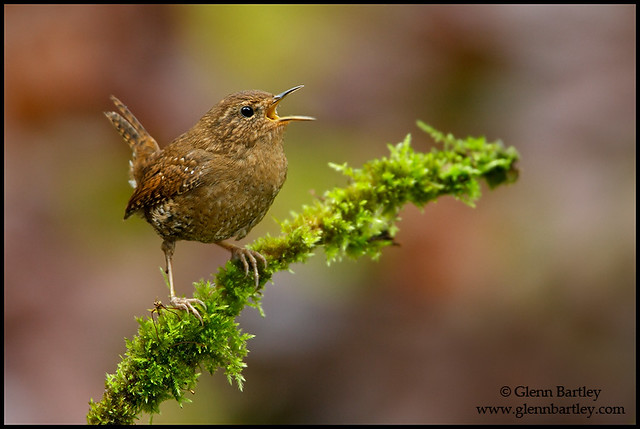
Warblers, wrens, kinglets, and most sparrows tend to conform very nicely to these generalizations regarding songs and calls. Take the vocalizations of the Pacific Wren for example. Their calls are very short, simple and repeated, while their songs are quite complex and can continue for up to 120 seconds (one of the longest wren songs ever recorded).

So what's the purpose of all this singing? The answer, as it often does in the natural world, brings us back to reproduction. Bird vocalizations are better defined as songs when we learn why they are produced. Singing behavior is a product of changes in hormone concentrations due to the lengthening of days. As days get longer in the spring, and the breeding season draws ever closer, the production of sex-related hormones (such as testosterone) spikes, and male songbirds begin singing their heads off every morning on your windowsill.

Calls, on the other hand, are not generally regulated by hormones. Instead they are communication- and coordination-related. Warning calls, contact calls, flight calls, foraging calls, distress calls, alarm calls - all of these sounds are produced for the coordination of behaviors. An alarm call will alert other birds in a flock to a predator. Flight, contact, and foraging calls help birds keep track of one another while moving in flocks (Bushtits for example). Distress calls can coordinate mobbing behavior, deterring predators. In fact, Black-capped Chickadees have been known to mimic the distress calls of other species, inciting more birds to join an anti-predator mob.

Pacific Wrens use songs to defend territories year-round.
Pacific Wren song:

Pacific Wren alarm calls:
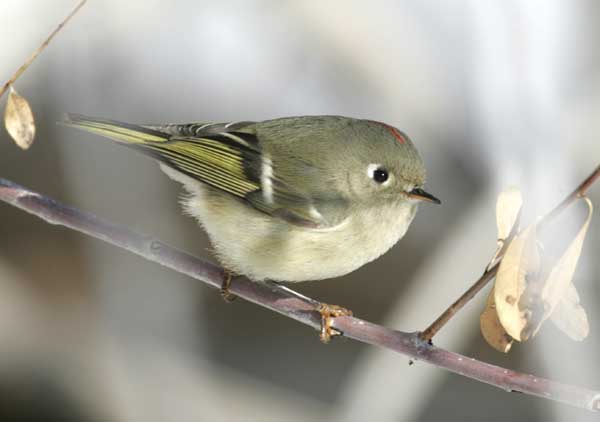
The diversity and repertoires of bird songs and calls is utterly astounding. Every year I hear chickadees, Steller's Jays, Bewick's Wrens and juncos make sounds I have never heard them produce before. I often feel like keeping up with new birdsongs is like trying to keep track of top-40 pop music! For a nice example of how songs can vary within a species, check out the "typical" Ruby-crowned Kinglet songs below.

Learning bird songs is a rewarding and enlightening experience. I have provided a few common songs and calls here to get you started. If you would like to continue your listening lessons, try looking up common bird songs on Xeno-Canto or in the Macaulay Library of Animal Sounds.

Also, it is interesting to note that exactly one year ago today, Dennis Paulson wrote a similarly themed blog entry about the arrival of spring and birds singing and breeding! Funny how the timing of this worked out! Check out last year's blog entry here.


- Robert Niese
Education and Outreach Coordinator

Bushtits use a variety of contact calls to keep track of one
another while foraging in large flocks. Listen to these calls below.
Song Sparrow songs are also quite common in my neck of
the woods. But don't get me started on song-variation in
sparrows. That's a topic for another day. Or week, perhaps.
Here's a typical song for Pacific Northwest Song Sparrows:

And here's a very nice recording of their alarm calls:
In my opinion, Ruby-crowned Kinglets sing one of the oddest
songs in Washington! Each song consists of three parts
 and each of those parts varies greatly between individuals.
Here is a "typical" song for a "Northwestern" Ruby-
crowned Kinglet. Note the three parts. The high-pitched
section, the descending twitter, and the see-sawing warble:

Now listen to how this individual from the Rockies changes his
song. It's different but we can still pick-out the three main parts:

Some birds will rearrange parts of their song, like this one from Quebec:

And then there are oddballs, like this population in British Colombia:

American Robins have remarkably diverse vocalizations.
Here is a typical Robin song:

This is an alarm call:

And here is another call type:
 

Tuesday, March 6, 2012

SANDERLINGS - BIRDS OF THE BEACH


Across the lonely beach we flit,
One little sandpiper and I,
And fast I gather, bit by bit,
The scattered drift-wood, bleached and dry.
The wild waves reach their hands for it,
The wild wind raves, the tide runs high,
And up and down the beach we flit,
One little sandpiper and I.

From The Sandpiper, by Celia Thaxter, 1883

Thaxter's writing about the poem makes it clear that its source was an encounter with a plover near its nest, but her description makes it sound as if she was watching a Sanderling (Calidris alba), the most common sandpiper on open ocean beaches almost anywhere in the world. Had it been a Sanderling, she would have marveled at its hyperactivity as it charged the ocean waves and then retreated as the waves charged back.

Sanderlings are particularly common on the Pacific Northwest coast, where the richness of the ocean waters enhances the productivity of the intertidal zone. The only higher densities recorded for the species in the Americas in winter are along the Humboldt Current beaches of Peru and Chile. Flocks of hundreds of birds occur all along our outer beaches, and they are tame enough (and presumably used to crowds of people) that you can watch their foraging behavior at great length.

Sanderlings dash in and out of the waves to get prey exposed by the receding water, but they also spend much time above the waves running around on either dry or wet sand. Like many other sandpipers, they can find their prey either visually or tactilely.

Tactile foraging involves plunging their slightly opened bill into the sand at frequent intervals as they run, like an animated sewing machine, to search for prey. When a prey item is felt, the bill tip closes on it and extracts it from the sand. Sanderlings foraging like this leave characteristic series of probe holes.

When foraging visually, a Sanderling moves just as rapidly and must have superb vision to see the tiny prey items that it seeks. Many amphipod crustaceans are taken this way, but some days they seem to be hunting thin worms, polychaetes of the family Capitellidae. This prey item is not mentioned in the most recent account of Sanderling natural history, yet all birds appeared to be feeding on them on a recent February visit to Long Beach, Washington.

A bird would move rapidly along, then suddenly stop and grab an incredibly thin worm and pull it quickly from the substrate. It would swallow it in a few gulps, sometimes running off while doing so. Birds were crisscrossing in front of us constantly, presumably spaced out to avoid direct competition for a single prey item. Hundreds of worms were being consumed, but I am sure there were many more where those came from.

Dennis Paulson

Nature Blog Network