Showing posts with label seasonality. Show all posts

Thursday, March 22, 2012

SINGING A DIFFERENT TUNE

A male Varied Thrush. Hear his unusual song below.
You know springtime is upon us when Varied Thrushes and Dark-eyed Juncos insist on waking you up at the crack of dawn with their incessant singing! Indeed, in the past few weeks, all manner of avian-related noise in my backyard has increased two- or threefold. Most of my feeder-frequenters have "changed their tunes," so to speak, from typical calls to territorial songs, making my neighborhood a much more melodious place.

Now, in case you were unaware, in the world of ornithology bird noises are classified into three groups: calls, songs, and mechanical sounds. A proper discussion of mechanical sounds would require an entire blog entry all on its own, so we'll hold off on that until a later date. For now, I hope you can be content with simply knowing that a mechanical sound is any non-vocal sound produced by a bird (such as bill clacking in ravens, drumming in woodpeckers, and the recently famous tail-squeak of Anna's Hummingbirds). For those of our dear readers with an insatiable and demmanding appetite for more knowledge, I shall leave you in the capable hands of your Google search bar (search for Chris Clark's research on tail sounds in Anna's Hummingbirds).

For the rest of us who haven't been sidetracked by mechanical sounds, I'll go ahead and get back to the calls and songs. What's the difference between these two types of vocalizations? In some species, the differences can be quite difficult to make out, but for others - most songbirds for example - they are as different as night and day - or perhaps, summer and winter? In general, most songs tend to be more elaborate, longer, and change with the seasons, while calls tend to be short and simple. As with most broad generalizations, there often appear to be more exceptions to the rule than conformists. Let's stick to the conformists for now.
A Dark-eyed Junco sings from his perch. Listen below.

Warblers, wrens, kinglets, and most sparrows tend to conform very nicely to these generalizations regarding songs and calls. Take the vocalizations of the Pacific Wren for example. Their calls are very short, simple and repeated, while their songs are quite complex and can continue for up to 120 seconds (one of the longest wren songs ever recorded).

So what's the purpose of all this singing? The answer, as it often does in the natural world, brings us back to reproduction. Bird vocalizations are better defined as songs when we learn why they are produced. Singing behavior is a product of changes in hormone concentrations due to the lengthening of days. As days get longer in the spring, and the breeding season draws ever closer, the production of sex-related hormones (such as testosterone) spikes, and male songbirds begin singing their heads off every morning on your windowsill.

Calls, on the other hand, are not generally regulated by hormones. Instead they are communication- and coordination-related. Warning calls, contact calls, flight calls, foraging calls, distress calls, alarm calls - all of these sounds are produced for the coordination of behaviors. An alarm call will alert other birds in a flock to a predator. Flight, contact, and foraging calls help birds keep track of one another while moving in flocks (Bushtits for example). Distress calls can coordinate mobbing behavior, deterring predators. In fact, Black-capped Chickadees have been known to mimic the distress calls of other species, inciting more birds to join an anti-predator mob.
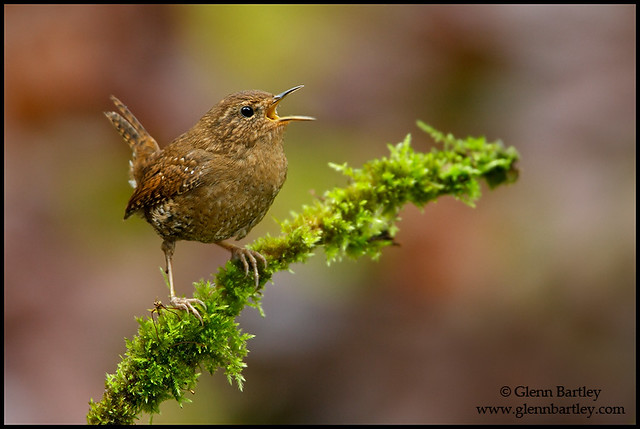
Pacific Wrens use songs to defend territories year-round.
Pacific Wren song:

Pacific Wren alarm calls:
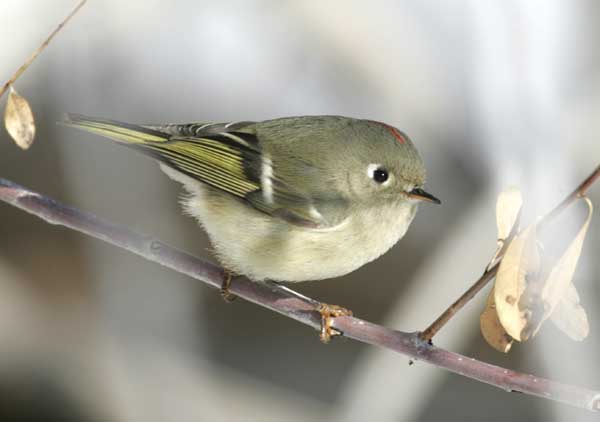
The diversity and repertoires of bird songs and calls is utterly astounding. Every year I hear chickadees, Steller's Jays, Bewick's Wrens and juncos make sounds I have never heard them produce before. I often feel like keeping up with new birdsongs is like trying to keep track of top-40 pop music! For a nice example of how songs can vary within a species, check out the "typical" Ruby-crowned Kinglet songs below.

Learning bird songs is a rewarding and enlightening experience. I have provided a few common songs and calls here to get you started. If you would like to continue your listening lessons, try looking up common bird songs on Xeno-Canto or in the Macaulay Library of Animal Sounds.

Also, it is interesting to note that exactly one year ago today, Dennis Paulson wrote a similarly themed blog entry about the arrival of spring and birds singing and breeding! Funny how the timing of this worked out! Check out last year's blog entry here.


- Robert Niese
Education and Outreach Coordinator

Bushtits use a variety of contact calls to keep track of one
another while foraging in large flocks. Listen to these calls below.
Song Sparrow songs are also quite common in my neck of
the woods. But don't get me started on song-variation in
sparrows. That's a topic for another day. Or week, perhaps.
Here's a typical song for Pacific Northwest Song Sparrows:

And here's a very nice recording of their alarm calls:
In my opinion, Ruby-crowned Kinglets sing one of the oddest
songs in Washington! Each song consists of three parts
 and each of those parts varies greatly between individuals.
Here is a "typical" song for a "Northwestern" Ruby-
crowned Kinglet. Note the three parts. The high-pitched
section, the descending twitter, and the see-sawing warble:

Now listen to how this individual from the Rockies changes his
song. It's different but we can still pick-out the three main parts:

Some birds will rearrange parts of their song, like this one from Quebec:

And then there are oddballs, like this population in British Colombia:

American Robins have remarkably diverse vocalizations.
Here is a typical Robin song:

This is an alarm call:

And here is another call type:
 

Wednesday, August 3, 2011

A LOT OF DRAGONFLIES

The Spiny Baskettail (Epitheca spinigera) is a dragonfly of the emerald family (Corduliidae) that occurs all the way across North America from Atlantic to Pacific. It is common in southern Canada and the northern tier of US states. It breeds in lakes, and apparently it can become very common in its optimal habitats.

It shares with numerous other species of Odonata the life-history trait of overwintering in the final larval instar and thus being ready to emerge as soon as its aquatic habitat warms sufficiently in spring. When this happens, apparently most of the larvae in the lake are ready to emerge at about the same time, so there are massive emergences over a period of a few days. I have yet to witness one of these (the larvae actually crawling out of the water, splitting their skins, and the adult that emerges flying away), but I did see the aftermath.

These scenes greeted us one sunny morning in June in southwestern Manitoba. Spiny Baskettails, hundreds and hundreds of them of both sexes, were hanging from every bare twig for several hundred meters along the entry road to Lake Audy in Riding Mountain National Park. The location is outside the Northwest, but the species occurs in the Northwest, so I consider it fair game.

Several things were of interest, besides the sheer staggering numbers of them. Very few were flying around, yet I would have thought there would be many prey insects in the air on this nice warm morning. Secondly, not a single one was resting on a leaf; every individual was hanging from a bare twig, even though it meant that when one was dislodged, it wasn’t that easy to find a new perching spot.

Several times we saw one try to land on the abdomen of a perched individual, but they were always shaken or buzzed off. All individuals were obviously immature, with reddish eyes. During sexual maturation, the eyes become glowing blue-green.

The sexes can readily be distinguished with a good view. Males have a slightly more slender abdomen base, with secondary genitalia projecting downward near the base, and three terminal appendages (two dorsal and one ventral). Females lack the bump at the base and have only the two dorsal appendages at the tip.

Mother Nature was showing off her profligacy in a big way here in an aspen woodland at the southern edge of the Canadian boreal forest.

Dennis Paulson


Tuesday, April 12, 2011

SPRING IS THE TIME FOR GROUND SQUIRRELS


It’s hard to conceive of a species spending most of its life asleep, but that’s the case for the spring ground squirrels.

Ground squirrels feed on herbaceous vegetation, and many of them are active throughout the summer and then hibernate during the winter. Some ground squirrels, however, live in arid deserts or grasslands in which lush growing vegetation is present only during the spring or during a summer rainy season. These species are active only during that time, so they are active above ground for only about a third of the year.

Two species that exemplify this scenario are the Washington Ground Squirrel (Spermophilus washingtoni) and Piute Ground Squirrel (Spermophilus mollis). Both are small, short-tailed species. Piute Ground squirrels occur in a limited area of sagebrush steppe in southern Washington between the Cascades and the Columbia River. Washington Ground Squirrels occur east of that river in the Columbia Basin. Both species have declined substantially in recent years as their habitat has been lost to agriculture.

Belding's Ground Squirrel (Spermophilus beldingi) is a slightly larger and more southerly species of the high desert in eastern Oregon and northern California. It has adapted very well to agriculture, so it is still abundant, but its life history is much like that of the other two.

Washington Ground Squirrels have litters of about eight young. They are born in late winter and emerge from their burrows about a month after the adults. A visitor to a ground squirrel colony around the beginning of April is treated to the sight of playful young on all sides, while the adults go about the business of serious eating.

After a few months of activity, with an abundance of fresh salads on the daily menu, first the adults and then the juveniles retire back into their burrows and spend the summer in a state of torpor called aestivation. Aestivation then grades into the usual winter hibernation. The longest an individual of these species spends above ground is about four months. One adult Washington Ground Squirrel in captivity was dormant for 244 days.

Juveniles grow to adult weight in two months after leaving the burrow. All individuals begin to deposit fat 6-8 weeks after emerging and end up with lipids comprising about 65% of their body weight when they go into the burrow for good. They then live through the summer, fall and winter on the fat deposited during the spring.

High temperature and low humidity are stressful on any animal, and as there is no new growth on the plants they favor, the spring-active ground squirrels have no source of water during the summer; thus aestivation. Aestivation is an adaptation for survival in hot, dry climates, just as hibernation is an adaptation for survival in cold climates. These small animals use both of these strategies, surviving by the fine tuning of their seasonal activity to their climate. How will global warming affect them?

Dennis Paulson
Nature Blog Network