Showing posts with label molt. Show all posts

Tuesday, March 3, 2015

A WHITE BLACK BIRD


I look at a lot of birds every year, and I don’t see many that are as cool as this one, a leucistic Black Turnstone (Arenaria melanocephala). This striking bird is wintering at the end of Sandy Point, north of Bellingham, Washington, in a flock of its relatives, and I finally got around to checking it out in February. I found the flock feeding on rocks at the mouth of the marina there.

What a bird! From a distance it looked entirely white, but at close range elements of the pattern became visible, most of them very subdued. The more or less straight line across the breast identified it as a Black rather than a Ruddy Turnstone (Arenaria interpres), which has a bilobed pattern of black there. There was also a Ruddy with the flock.


By comparing the bird with a normal Black Turnstone, I could see how much the melanin pigment was reduced on this bird, yet it wasn’t entirely absent. The darkest areas of normal pigment were on the rump and tail, but tan areas all over the bird, most readily seen in flight, gave me a good hint of typical Black Turnstone pattern.

The bird is definitely leucistic, not albinistic, because it has normally pigmented eyes. Albinism is the complete absence of melanin pigment. Because that pigment is what gives brown eyes their color, when it is lacking in an albino, the blood vessels in the eyes give them a bright red color. Leucism is a reduction of all pigments, but not necessarily their absence.

The bird presumably grew most of its feathers in July and August, the time of fall molt in Black Turnstones, so they were about six months old in February and showing their age. In comparison with nearby normal birds, the primary feathers were distinctly more worn. The tertials, the long feathers that overlie the primaries, were very worn, much more than on the other birds.

The bright orange legs of this bird contrasted with those of normal Black Turnstones, in which they are brown to dull orange. Presumably in normal birds, melanin masks what would be bright orange otherwise. The legs of Ruddy Turnstones are bright orange, and one wonders whether they would remain exactly the same in a leucistic bird.


Its behavior appeared to be the same as that of the other birds, and they must have accepted it as a flock member. However, when the entire flock flew away, startled by a jogger coming down the beach, the white bird flew in the opposite direction with two of the black ones rather than with the flock.

Such birds are extremely rare, and I feel fortunate to have seen this one. One thing special about it is that it could never be mistaken for another turnstone, thus always recognizable. If we could recognize all birds individually, we would know a lot more about them!

The white turnstone’s presence is being monitored closely, so we may know when it has departed for the north, assuming some local falcon doesn’t pick it out of the flock. It is well known that birds of prey will home in on odd-looking birds, as they are easiest to follow in a twisting, turning flock.

If it does persist into spring, local birders will be watching closely for it late next summer, when Black Turnstones return here from their breeding grounds in the Yukon/Kuskokwim River delta. Let’s hope it makes it back.

Dennis Paulson

Tuesday, September 10, 2013

THE SHOREBIRDS ARE BACK


In fact, southbound migratory shorebirds have been back in the Pacific Northwest since the last week of June, but it is timely to write about them, as they are probably at their peak at the beginning of September.

The adults come back as soon as their young fledge, but of course some nests fail, and those adults are the first to return. Why stay in the Arctic, with all those mosquitoes and arctic foxes, when where you really should be is on a mud flat in Grays Harbor or a sandy beach in Sinaloa? Some of them are going farther, well into South America, so they had better get an early start for that long flight.

In quite a few shorebird species, one sex deserts the other adult and the offspring soon after the eggs hatch. The majority of these are females, presumably because females have expended much energy producing the eggs, so to balance parental investment, the males are left to raise the young. Most shorebirds don’t feed their young, so raising young shorebirds consists of shepherding them around to feeding sites and warning them about potential predators. It’s still a lot of work (imagine keeping track of four kids when you can’t see them much of the time).

Perhaps because they are big enough to potentially ward off predators, large shorebirds such as curlews and godwits divide parental responsibility, and the sexes migrate together. This is also true of most plovers. But the first Western Sandpipers you see in fall are probably those that failed at nesting, then a large wave of females that have left their families, then the males.

Many of these species undergo body molt while they are migrating, so in the fall we see birds in breeding plumage, in nonbreeding plumage, and at all stages in between. In addition, another plumage complicates the issue. These are the juveniles, young of the year that migrate after the adults. The peaks of their migration are often about a month apart, so in some species that continue south after passing through our region, we see a lot of adults and then a lot of juveniles, but not much mixing.

When trying to identify unknown shorebirds, it is extremely important to place them in a plumage, or at least an age stage. In fall, the adults have very worn body feathers until they are all replaced, and many of them don’t replace all their feathers until some time in the winter. Of the flight feathers, both the primaries and the tertials (the feathers of the inner wing that cover the primaries when the wing is folded) become very worn, and that wear is easily seen. Juveniles, on the other hand, have neat unworn feathers, including the primaries and tertials.

Get out to the coast and savor the shorebirds. You can easily see one to two dozen species on a good day, and identification is much facilitated because they are often in mixed-species flocks.

Dennis Paulson

Tuesday, July 9, 2013

“TIS THE SEASON TO EAT DUCKLINGS,


Fa la la la la, they’re good for you.”

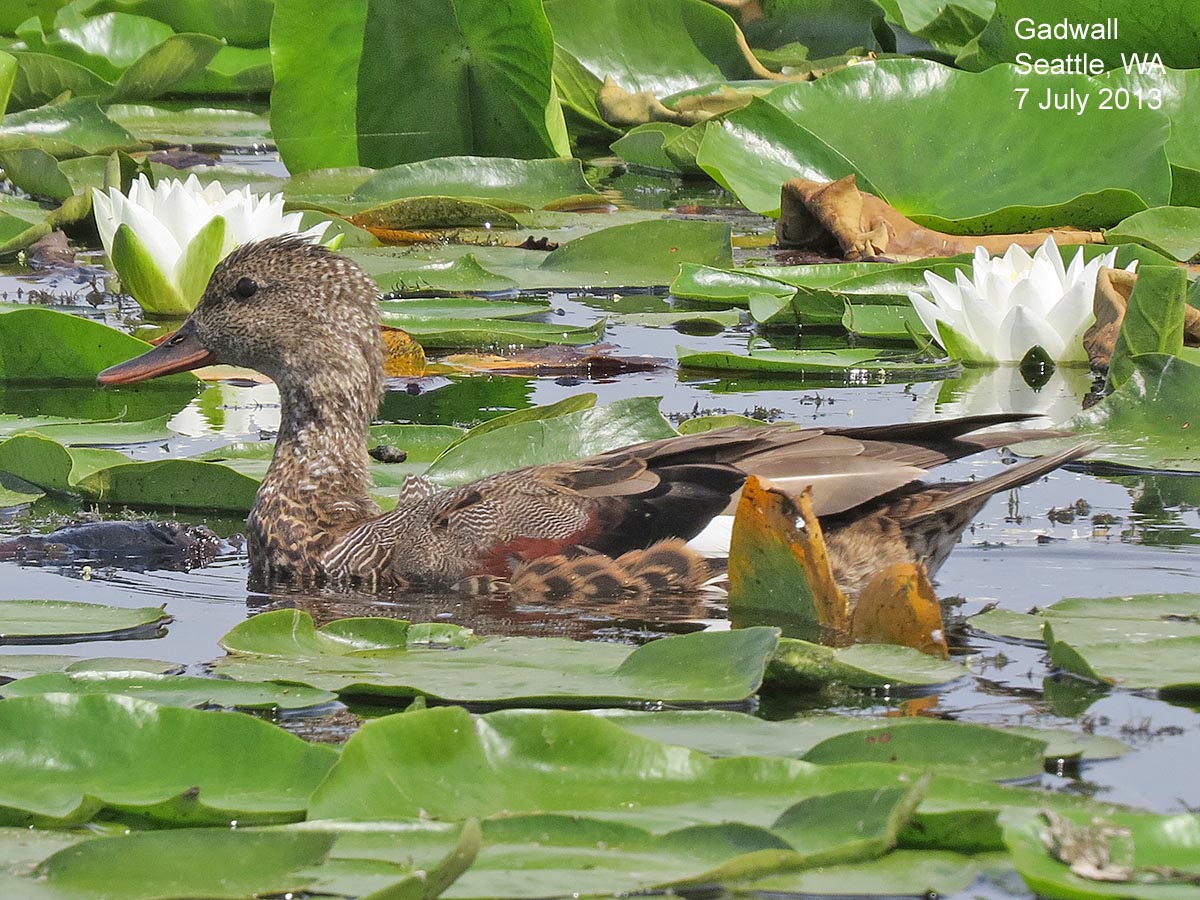
This just might be the spring song at the top of the Coyote Hit Parade. Ducks have been breeding for the past several months in the Pacific Northwest, and there is a steady supply of cute, fuzzy, edible ducklings. Mallards were first, and many of them have full-sized young now. They were followed by other species, including Gadwalls, the second most common breeding duck in western Washington.

Ducks lay clutches of around 8-10 eggs and incubate them for almost a month to hatching. Incubation begins when the last egg is laid, so the young all develop synchronously and hatch at about the same time. The female leads the ducklings from the nest off to a good wetland feeding area, watching carefully for predators.

She can warn her offspring to hide, but she can’t do much to protect them against the predatory mammals, birds, snakes, frogs and fish that might relish a duckling meal. A duckling might be a snack for a Coyote, a good lunch for a Mink, or an overstuffed belly for a Bullfrog.

The downy (cute) stage in a Mallard lasts about 25 days, and then they begin feathering out and enter their gawky “teenager” stage.  After another few weeks, they are fully feathered, and they can fly at around two months of age; most broods are abandoned by the female then or a bit before.

Males of most species of ducks desert their mates when incubation begins, but in city ducks, it seems that more and more males can be seen with their families, at least early in the season, and one wonders if there are genetic changes happening in these populations.


The males begin to molt out of their definitive plumage soon after leaving the females, changing to a female-like eclipse plumage and eventually molting all their flight feathers simultaneously. The Gadwall shown here is entering that plumage. After their brood has fledged, females also undergo a complete molt, although they don’t change plumage.

Meanwhile, predators are taking their toll. Rarely will you see a complete brood of ducklings. Instead, the numbers decrease week by week until there are often only a few left with any given female. Sometimes females combine broods, raising the level of predator awareness with two pairs of eyes, but the young still remain relatively unprotected.

In any case, all a pair has to do is raise two young successfully in their lifetimes to keep populations stable. Waterfowl populations as a whole are doing well, so those females must be doing something right! Perhaps it’s good that not all those ducklings survive, as wouldn’t we be knee-deep in ducks at some point?

Dennis Paulson

Thursday, May 2, 2013

BLACK-BELLIED PLOVERS - NOT ALWAYS BLACK-BELLIED


Many of the common names given to organisms are descriptive, but sometimes the description is valid for only some of the individuals. Take the Black-bellied Plover (Pluvialis squatarola), for example. Forgetting for a moment that the undertail coverts, which some might take as part of the belly, are snow-white, the males of this species have lustrous black bellies, and in fact almost entirely black underparts.

Female Black-bellied are similar to males but duller above, more brownish in comparison with the males' more spangled black and white look. They also may have some white intermixed with the black of the underparts. Nevertheless, they are clearly black-bellied Black-bellied.

However, this is true for only half the year; the underparts are black only in alternate (breeding) plumage, from April to August or September. For the rest of the year, in basic (nonbreeding) plumage, the underparts of both sexes look entirely white at a distance; brown streaks and bars are apparent at closer range. the upperparts are light brown, with slightly darker markings at this time.

Furthermore, most birds don't get black underparts until they are at least two years old. Juveniles fresh off the Arctic breeding grounds look much like basic-plumaged adults but are a bit darker above, with light markings on the feathers. These birds get increasingly faded and worn during their first winter and spring, then molt into a plumage much like the adults' basic plumage for their second year of life. In their second spring, their plumage is identical to that of the adults.

Even more fun, if confusion can be fun, it takes the birds about a month to molt between these plumages, so there are black-and-white-bellied plovers present during one-sixth of the year. This is mostly in March and September, but not all individuals molt on the same schedule, so these intermediate birds can be present at other times.

One of the most interesting aspects of the plumages of this species is the sexual dimorphism. Males conduct aerial displays on the breeding grounds, so it is understandable why they are black below to be more visible against the sky. But why then should females share the color? They are duller than males, but their plumage change at breeding time is still quite substantial. Perhaps different plumages just function for sex recognition, as they do in so many birds, but then why aren't all shorebirds sexually dimorphic?

Black-bellied Plovers are abundant migrants on the Washington coast and also winter in some numbers, both on the outer coast and in protected estuaries in the Strait of Juan de Fuca and Puget Sound. They are usually in flocks, and an observer with a good spotting scope can study all of these plumages at different times of year.

Dennis Paulson

Tuesday, September 7, 2010

DIFFERENT MOLT STRATEGIES


Most birds molt their flight feathers in a fairly straightforward way, as explained in the last blog. The feathers on each wing molt sequentially, starting with the innermost primary and usually ending with the innermost secondary. This is called sequential wing molt.

But there are two other ways to do it.

Very large birds (above about 1 kilogram in weight) that need to be able to fly at all times, for example eagles, cormorants, and herons, can retain feathers for more than one year and molt only some of them each year. The largest among these take about three years to replace all the flight feathers. This molt strategy is called stepwise wing molt.

In many large birds, you can see the different feather generations in an outspread wing because the older feathers are more worn and thus a bit paler. These differences should be evident in this Turkey Vulture wing specimen from the Slater Museum collection.

The other strategy is simultaneous wing molt. If predation is the only reason they need to be able to fly, and birds can avoid predation, they can give up flight for a period of time and drop all their flight feathers simultaneously. This is the case in anhingas, ducks and geese, loons, grebes, and larger alcids, all of which can remain in the water during this period, out of range of their potential predators. Note this group includes the very large swans and geese, which perhaps could not fly very efficiently with gaps in their wings.

The female Mallard is typical of midsummer ducks with all flight feathers missing. The Common Murre also is in full wing molt, usually obvious because the wingtips can’t be seen above the tail.


This Anhinga has dropped all of its flight feathers and most of its tail feathers simultaneously and is in the process of growing them back.

Dennis Paulson


IT'S TIME TO MOLT


All birds have a complex coat of feathers, thousands of them, which they use for insulation, display, camouflage, and flight. Look at a feather closely and you’ll see that it looks flimsy, yet it does its job very well by meshing with others of its kind. Flight feathers can hold up birds such as Trumpeter Swans that weigh in excess of 30 pounds and provide thrust and lift for continuous flight in birds on migrations that extend thousands of miles.

But these feathers, while strong, are not indestructible. Inexorably, a feather wears over its lifetime, and if a bird grew only one coat of them, eventually wear would take its toll. If not naked, a bird would look rather frazzled. Over time the feathers would lose their strength and insulating ability as the microscopic structures that hold them together wore off. Look at the same feather when about a year old, and you can easily see that wear. This Little Gull wing in the Slater Museum collection, from a one-year-old bird just molting into its second set of wing feathers, shows you how worn feathers can become before they are replaced.


The solution to this problem is the annual molt that all birds undergo. All the feathers on the body are replaced each year, usually soon after breeding, which would be in fall in our north temperate zone. Not only are the contour feathers of the body replaced, but all wing and tail feathers are replaced as well, except in the very large birds in which this isn’t energetically possible (see next blog post).

It takes a lot of physiological energy to grow a feather, so molting is a fairly slow process. A complete body molt takes as long as a month for an average songbird. Individual flight feathers take about three weeks to replace completely, so a complete wing molt may take a month or more. These constraints are very important to migratory birds, as they may not be able to migrate until they have finished growing all their flight feathers, and they molt only after breeding, with its own energetic demands, has been completed.

Wing molt is typically sequential. The innermost primary is shed, and its replacement begins to grow. Before it completes its growth, the second primary is shed and its replacement begins to grow. Etc. The molt progresses out the primaries and, at some point, begins in the secondaries, where it moves from the outermost (adjacent to the primaries) inward. This gull is in the middle of primary molt, with the two outermost feathers from the previous generation and the feather just in from those growing in. You can also see that some of the outermost secondaries have been shed.


This adult Black Turnstone shows body molt (worn brownish feathers being replaced by crisp blackish ones) and wing molt (worn brown primaries and newly grown blackish ones, with a gap where the intervening feathers have been shed and are regrowing). Most birds would look something like this in fall.

Of course, in birds that change plumage color between breeding and nonbreeding times, molt of the body feathers must occur twice each year, spring and fall. This molt is one of the most obvious ones to those of us who look carefully at birds. This juvenile Short-billed Dowitcher is just beginning its molt into its dull first-winter (much like adult) plumage; the scapular feathers are often the first to molt.

Dennis Paulson
Nature Blog Network