Showing posts with label diving. Show all posts

Tuesday, February 14, 2012

MEET THE ALCIDS


Do you know your alcids? Most people know what gulls and terns are, and sandpipers are familiar even if the multitude of species can't be distinguished. Skimmers and skuas are less known, but it doesn't take a stretch to believe it when you learn they are related to gulls and terns. These birds are all in the same order, Charadriiformes, indicating their close relationship. But there is another group in the order that is not so obviously related to the others. These are the alcids, members of the family Alcidae.

Alcids are diving birds, much like loons and grebes and ducks in their general appearance and habits. They are relatively short-necked compared with other diving birds, so that in flight they look as much like footballs as birds. These footballs have wings, of course, but they use them not only for swimming but also for flying. Very few birds swim underwater with their wings rather than their feet, but these birds do. This method of locomotion is called wing-propelled diving.

The best-known wing-propelled divers are penguins, but they can't fly. Alcids do both, and quite well. In flight their relatively small wings keep them from soaring or gliding like a gull or turning on a dime like a sandpiper, but as long as they keep them beating at high speed they do very well in powered forward flight. When they try to turn, they slide sideways in the air before changing direction.

Wing loading is weight divided by wing area. The wing loading of these birds is very high, so they have to run along the water to take flight, into the wind whenever possible. They try to get all the lift they can, so they flatten their body and spread out their tail and webbed feet to increase the lift surface. Sometimes they splash along the surface before actually getting airborne.

Four species of alcids are common in Puget Sound, and all are fish-eaters. Common Murres and Rhinoceros Auklets breed widely in large colonies, the murres on cliff ledges and the auklets in burrows they dig. Both species are present in the Sound primarily in winter, but the auklets breed as close as Protection Island, and many forage in the northern part of the Sound during that period.

Both of these species are adapted to go where the fish are, and as schools of herring and sand lance are local and on the move, the birds adopt the same strategy. In an area with currents, diving birds commonly float downcurrent through areas rich in marine life, often around upwellings, feed as they can, then fly upcurrent to make the same journey again. Obviously these activities change with the changing of the tides, and they can be seen best in rich areas with powerful tide exchange such as Admiralty Inlet.

Marbled Murrelets feed in the same areas and even on the same fishes, but they are much less common. That species is unique in being a forest breeder. Pairs remain together throughout the year, then fly into old-growth forests in the spring to nest on a branch high in a big Douglas-fir. Because they use old growth, their populations have declined greatly in historic times.

Pigeon Guillemots breed locally in the sound, either in holes they dig at the tops of banks or in crevices under docks. They feed primarily on bottom fishes such as sculpins and gunnels, and they are the only one of the group that uses their feet as well as their wings as paddles as they move slowly over the bottom searching for prey.

The alcids are characteristic and charismatic birds of Pacific Northwest marine environments, and ferry travel is a good way to see them. Spend time at and especially on Puget Sound and learn about them for yourself.

Dennis Paulson


Friday, December 17, 2010

DIVING BIRDS

Many kinds of birds dive for a living. Not from a diving board, but from the air or the water surface. Some of these birds fly over the water, see potential prey, and dive from the air to attempt capture. These birds are called plunge divers. Gulls plunge into the water to about their own body length and retrieve prey from near the surface. Terns, some pelicans, tropicbirds, and boobies dive from above the surface, the first three penetrating farther into the water column than the gulls do. Boobies (and their close relatives the gannets) penetrate well below the surface and actively chase fish underwater.

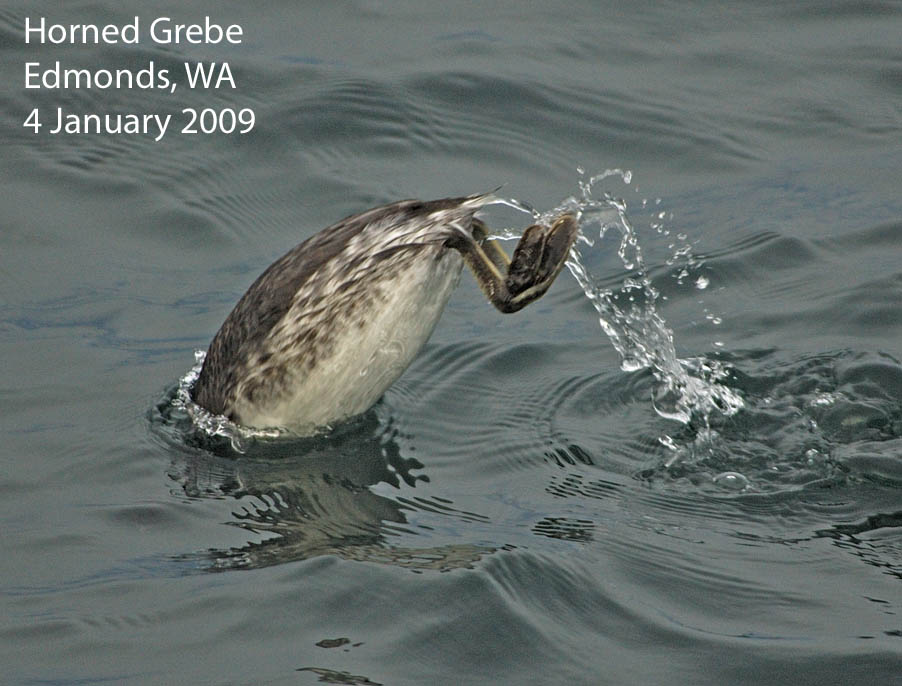
Many other birds dive from the water surface, including loons, grebes, cormorants, alcids (puffins and their relatives), diving-petrels, some shearwaters, coots, and many ducks. In this discussion let’s look at this group, so-called surface divers.

All diving birds have feet that are modified for swimming at the surface, and these same feet serve them well for underwater propulsion. The typical swimming foot is that of a duck, with the three forward toes joined by webs. The hind toe is much reduced. Among the diving birds, these webbed feet also characterize loons, gulls, terns, shearwaters, diving-petrels, and alcids (this last group lacks a hind toe).

A variation on this is to have the hind toe lengthened and all four toes connected by webs. This characterizes cormorants, pelicans, boobies, and tropicbirds. Finally, instead of webs, some birds have each of the toes, including the hind one, provided with large, flat lobes that are equally efficient in propelling the bird forward. Divers with lobed toes include grebes and coots.

Surface divers vary quite a bit in how they dive and how they locomote under water. Most of them just put their head down, slide under the surface, and propel themselves downward. Although the feet stroke alternately while swimming on the surface, when underwater they stroke in unison, like a pair of oars, and they are held out to either side. This must use different sets of muscles than those used for swimming on the surface. Smaller birds such as grebes, coots, and small cormorants may jump up into the air to enter the water with more momentum.

One group of birds exhibits a real variation in this theme. The alcids are wing-propelled surface divers, using their wings to swim just as if they were flying underwater. As they go below the surface, you can see their wings already open as their means of propulsion. In the guillemots, which feed on bottom fish, the feet are used along with the wings, but in murres and puffins and others that feed on midwater fish and krill, they are held behind and not used at all. The southern-hemisphere diving-petrels, related to true petrels, also use this method of propulsion, as do penguins. Not able to fly, penguins are the most highly modified birds for underwater living.

Scoters and some other sea ducks such as Long-tailed Ducks open their wings as they dive, easily seen. They may use them as diving planes underwater or may actually flap them just as alcids do. For the most part, diving birds surface just by stopping their underwater propulsion and, like a cork, popping back up to the surface. They go headfirst, the most streamlined way to go. Alcids sometimes swim actively upward and penguins always do.

Although you would think that fish are the fastest swimmers in the sea, the most amazing thing about diving birds to me is that they can swim faster than the fish, presumably a necessity if they are to catch them! Both animals streak through the water, and just like a smaller bird trying to escape from a hawk, the fish may or may not escape.

Still photos of birds swimming underwater are very hard to come by, although YouTube and other such online video sites show a variety of birds swimming underwater, very often misidentified (grebes and alcids called “ducks”). Notwithstanding these few videos, we have much to learn about how diving birds forage underwater.

Dennis Paulson
Nature Blog Network