Showing posts with label song. Show all posts

Friday, November 30, 2012

PSYCHEDELIC ROBIN OF THE NORTHWEST


Some people, seeing their first Varied Thrush (Ixoreus naevius), wonder if they are having vision problems. This psychedelically colored thrush looks more or less like an American Robin (Turdus migratorius) and feeds on the ground or in fruit trees like a robin, but the similarity is only superficial.

Male Varied Thrushes are vividly colored in gray, black and russet, much more brightly patterned than robins. Females are more subdued, with less conspicuous facial markings and breast band, but they still show the vivid wing markings typical of the species. Note also their black instead of yellow bill.

While robins run about our yards looking for earthworms that have surfaced, Varied Thrushes are foraging for a much greater variety of invertebrates. A robin is a visual forager, cocking its head to scan for worms, but a Varied Thrush gets down and dirty, pulling leaf litter up and hopping backward to examine the ground exposed. The complex web of life beneath the litter furnishes up dietary items one after another to the thrush.

In addition, Varied Thrushes take fruits and seeds of all kinds, even acorns, from the ground. They often visit bird feeders to take seeds or suet, something robins never do. Both species are attracted to fruiting trees and shrubs, where they may gobble berry after berry, jumping up or briefly hovering to pull them from branches to small for a comfortable perch.

Varied Thrushes breed in wet conifer forests in the mountains of the Pacific Northwest, and they are present in the lowlands only in winter, when they come down from the mountains. In some winters, probably the colder and snowier ones, they are more common than at other times, numerous enough to be called an invasion. At intervals they wander much more widely than their usual range in the far West, turning up as far east as the Atlantic coast.

The call note of a Varied Thrush is a sharp 'tup,' much like that of a Hermit Thrush, but the song is magical. It is a series of drawn-out notes at different pitches, sometimes with overtones. Note after note comes out of the bird with an ethereal quality that seems well suited for our dark evergreen forests. Fortunately for us, they sing commonly in the spring before they depart for the mountains, so you may hear this song in your suburban yard.

Watch for the psychedelic robin; it's that time of year!

Dennis Paulson

Thursday, March 22, 2012

SINGING A DIFFERENT TUNE

A male Varied Thrush. Hear his unusual song below.
You know springtime is upon us when Varied Thrushes and Dark-eyed Juncos insist on waking you up at the crack of dawn with their incessant singing! Indeed, in the past few weeks, all manner of avian-related noise in my backyard has increased two- or threefold. Most of my feeder-frequenters have "changed their tunes," so to speak, from typical calls to territorial songs, making my neighborhood a much more melodious place.

Now, in case you were unaware, in the world of ornithology bird noises are classified into three groups: calls, songs, and mechanical sounds. A proper discussion of mechanical sounds would require an entire blog entry all on its own, so we'll hold off on that until a later date. For now, I hope you can be content with simply knowing that a mechanical sound is any non-vocal sound produced by a bird (such as bill clacking in ravens, drumming in woodpeckers, and the recently famous tail-squeak of Anna's Hummingbirds). For those of our dear readers with an insatiable and demmanding appetite for more knowledge, I shall leave you in the capable hands of your Google search bar (search for Chris Clark's research on tail sounds in Anna's Hummingbirds).

For the rest of us who haven't been sidetracked by mechanical sounds, I'll go ahead and get back to the calls and songs. What's the difference between these two types of vocalizations? In some species, the differences can be quite difficult to make out, but for others - most songbirds for example - they are as different as night and day - or perhaps, summer and winter? In general, most songs tend to be more elaborate, longer, and change with the seasons, while calls tend to be short and simple. As with most broad generalizations, there often appear to be more exceptions to the rule than conformists. Let's stick to the conformists for now.
A Dark-eyed Junco sings from his perch. Listen below.

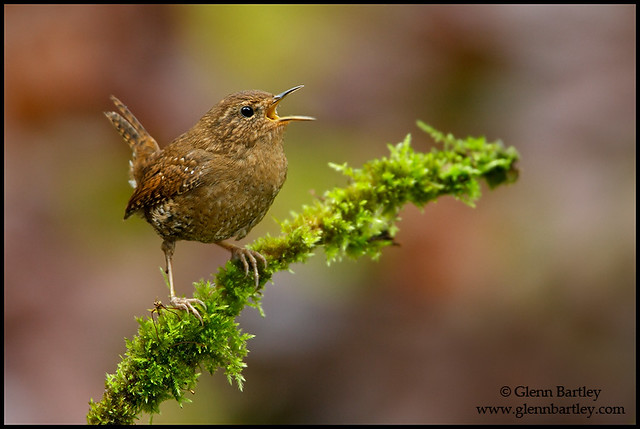
Warblers, wrens, kinglets, and most sparrows tend to conform very nicely to these generalizations regarding songs and calls. Take the vocalizations of the Pacific Wren for example. Their calls are very short, simple and repeated, while their songs are quite complex and can continue for up to 120 seconds (one of the longest wren songs ever recorded).

So what's the purpose of all this singing? The answer, as it often does in the natural world, brings us back to reproduction. Bird vocalizations are better defined as songs when we learn why they are produced. Singing behavior is a product of changes in hormone concentrations due to the lengthening of days. As days get longer in the spring, and the breeding season draws ever closer, the production of sex-related hormones (such as testosterone) spikes, and male songbirds begin singing their heads off every morning on your windowsill.

Calls, on the other hand, are not generally regulated by hormones. Instead they are communication- and coordination-related. Warning calls, contact calls, flight calls, foraging calls, distress calls, alarm calls - all of these sounds are produced for the coordination of behaviors. An alarm call will alert other birds in a flock to a predator. Flight, contact, and foraging calls help birds keep track of one another while moving in flocks (Bushtits for example). Distress calls can coordinate mobbing behavior, deterring predators. In fact, Black-capped Chickadees have been known to mimic the distress calls of other species, inciting more birds to join an anti-predator mob.

Pacific Wrens use songs to defend territories year-round.
Pacific Wren song:

Pacific Wren alarm calls:
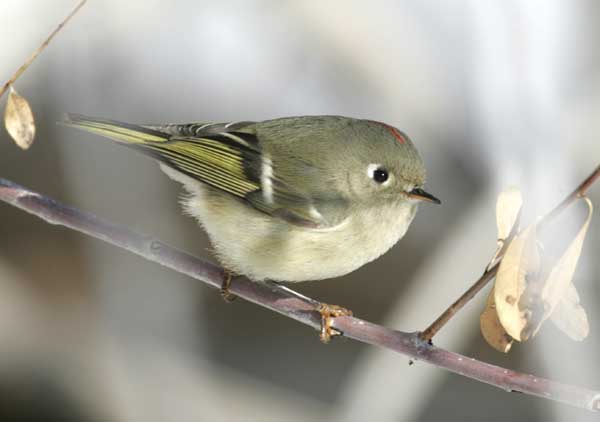
The diversity and repertoires of bird songs and calls is utterly astounding. Every year I hear chickadees, Steller's Jays, Bewick's Wrens and juncos make sounds I have never heard them produce before. I often feel like keeping up with new birdsongs is like trying to keep track of top-40 pop music! For a nice example of how songs can vary within a species, check out the "typical" Ruby-crowned Kinglet songs below.

Learning bird songs is a rewarding and enlightening experience. I have provided a few common songs and calls here to get you started. If you would like to continue your listening lessons, try looking up common bird songs on Xeno-Canto or in the Macaulay Library of Animal Sounds.

Also, it is interesting to note that exactly one year ago today, Dennis Paulson wrote a similarly themed blog entry about the arrival of spring and birds singing and breeding! Funny how the timing of this worked out! Check out last year's blog entry here.


- Robert Niese
Education and Outreach Coordinator

Bushtits use a variety of contact calls to keep track of one
another while foraging in large flocks. Listen to these calls below.
Song Sparrow songs are also quite common in my neck of
the woods. But don't get me started on song-variation in
sparrows. That's a topic for another day. Or week, perhaps.
Here's a typical song for Pacific Northwest Song Sparrows:

And here's a very nice recording of their alarm calls:
In my opinion, Ruby-crowned Kinglets sing one of the oddest
songs in Washington! Each song consists of three parts
 and each of those parts varies greatly between individuals.
Here is a "typical" song for a "Northwestern" Ruby-
crowned Kinglet. Note the three parts. The high-pitched
section, the descending twitter, and the see-sawing warble:

Now listen to how this individual from the Rockies changes his
song. It's different but we can still pick-out the three main parts:

Some birds will rearrange parts of their song, like this one from Quebec:

And then there are oddballs, like this population in British Colombia:

American Robins have remarkably diverse vocalizations.
Here is a typical Robin song:

This is an alarm call:

And here is another call type:
 

Thursday, June 2, 2011

THE CHORUS OF THE CHORUS FROGS

Early every year in the Pacific Northwest a familiar sound rings out, telling us it is spring whether it seems that way or not. this is the “song” or advertisement call of the male Pacific Chorus Frog, Pseudacris regilla.

Most people recognize the call immediately as the generic frog call of movies in decades past. As this is a common frog (or at least used to be) in Hollywood, California, its call was incorporated into many a movie that needed frog calls as ambience. In fact the “ribbit, ribbit” sound has become the stereotype of frog calls.

These frogs come out of their winter dormancy very early in spring, when, to paraphrase Robert Burns, a young frog’s fancy lightly turns to thoughts of love. The only way a frog has to express itself in such a situation is to call . . . . and call . . . . and call. And that they do, with surprising strength.

When a male frog feels these stirrings, he heads for the nearest pond or marsh, usually in the evening but sometimes even during the day. On arrival, he jumps in the water and swims to what he considers a good position. Only the frog knows why it is a good position, but it probably provides a place to hold onto the vegetation and a place where he can be easily seen as well as heard. Interestingly, it is often the same male that calls first each evening.

He begins to call: ribbit, ribbit, ribbit, a creaky two syllables that carries at least a hundred yards or more on a quiet night. Another frog heads for the pond, either because hopping downhill in a moist environment will lead to water or because it homes in on the first frog. The second frog begins to call, perfectly insinuating its calls between those of the first. The two may sound quite different, so we hear ribbit, rabbit, ribbit, rabbit, ribbit, rabbit.

A third male begins to call, amazingly also able to insert its calls into the soundscape so they can be heard as distinct: ribbit, rabbit, robbit, ribbit, rabbit, robbit . . . the pace is speeding up, and there is no room for a fourth frog, but that one calls anyway. As the chorus swells, the individual voices become less apparent, even though the structure may still be there, but a female approaching the pond can easily distinguish the individual voices.

Females apparently choose males based on the vigor of their songs, and as the evening progresses, more and more males acquire a mate. The male clasps the female and stays with her while she looks for a place to lay her eggs. She finds such a place, lays a cluster of eggs, and the male fertilizes them.

The eggs hatch in a few days, and the tadpoles grow quickly on a diet of plant matter. After a few months, they finally absorb their tails and grow a set of limbs and are then ready to leave the pond. If they survive the year, they will return the following spring, and the pond will resound again with the chorus frog chorus.

Dennis Paulson
Nature Blog Network