Showing posts with label songbirds. Show all posts

Tuesday, January 8, 2013

SHRIKES, SONGBIRDS OF PREY


We are all familiar with hawks and owls, raptorial birds with strong feet and long, curved talons for capturing and carrying prey and a strong, sharp-edged, hooked bill for tearing that prey into bite-sized morsels.

But there is another group of common birds that are just as predatory, although with somewhat different anatomy. These are the shrikes. Shrikes are members of the perching bird order Passeriformes, and although that order is full of insect eaters (shrikes do this), it's not so full of birds that eat small vertebrates such as lizards, songbirds and rodents (shrikes do this too).

Loggerhead Shrikes (Lanius ludovicianus) are widespread breeders in interior sagebrush habitats in the Pacific Northwest. With us only in the summer, they feed primarily on large insects such as grasshoppers and beetles, but they also eat small vertebrates whenever they can capture them, including voles and birds right up to their own size.

Northern Shrikes (Lanius excubitor) breed in the boreal forest and drop down to the PNW in the winter. They are more widespread than Loggerheads, occurring throughout the region in open country. Although they take many insects on their breeding grounds, Northerns are bird and mammal eaters in the winter. Voles are among their most common prey, but they will chase and capture small birds of any sort.

Shrikes have typical perching-bird feet, not raptorial, and they don't capture or kill their prey with their feet, but they do use their feet to carry prey, especially heavy items and even up to their own weight; otherwise prey is carried in their bill.

Although not just like a hawk's, the bill is strong and hooked at the end. It has a pair of toothlike structures near the tip of the upper mandible (tomial teeth) that are important in prey-killing. The shrike bites a vertebrate just behind the head, and the "teeth" apparently sever or injure the spinal cord sufficiently to kill or paralyze the prey, which then cannot struggle and possibly injure the predator.

Not having feet to hold a prey animal down while tearing pieces of flesh off, shrikes have evolved a substitute. They carry their prey to something on which they can position it. In nature, this would involve impaling on thorns or hanging from crotches where two branches diverge. They can then begin to dismember the prey.

Having evolved this behavior and often taking prey much too large to be eaten in one session, shrikes further evolved the behavior of leaving the prey hanging and returning later to eat some more. Wherever shrikes occur, such prey are liable to be found. Nowadays, we can watch for shrike prey caches on barbed-wire fences!

Dennis Paulson

Thursday, March 22, 2012

SINGING A DIFFERENT TUNE

A male Varied Thrush. Hear his unusual song below.
You know springtime is upon us when Varied Thrushes and Dark-eyed Juncos insist on waking you up at the crack of dawn with their incessant singing! Indeed, in the past few weeks, all manner of avian-related noise in my backyard has increased two- or threefold. Most of my feeder-frequenters have "changed their tunes," so to speak, from typical calls to territorial songs, making my neighborhood a much more melodious place.

Now, in case you were unaware, in the world of ornithology bird noises are classified into three groups: calls, songs, and mechanical sounds. A proper discussion of mechanical sounds would require an entire blog entry all on its own, so we'll hold off on that until a later date. For now, I hope you can be content with simply knowing that a mechanical sound is any non-vocal sound produced by a bird (such as bill clacking in ravens, drumming in woodpeckers, and the recently famous tail-squeak of Anna's Hummingbirds). For those of our dear readers with an insatiable and demmanding appetite for more knowledge, I shall leave you in the capable hands of your Google search bar (search for Chris Clark's research on tail sounds in Anna's Hummingbirds).

For the rest of us who haven't been sidetracked by mechanical sounds, I'll go ahead and get back to the calls and songs. What's the difference between these two types of vocalizations? In some species, the differences can be quite difficult to make out, but for others - most songbirds for example - they are as different as night and day - or perhaps, summer and winter? In general, most songs tend to be more elaborate, longer, and change with the seasons, while calls tend to be short and simple. As with most broad generalizations, there often appear to be more exceptions to the rule than conformists. Let's stick to the conformists for now.
A Dark-eyed Junco sings from his perch. Listen below.

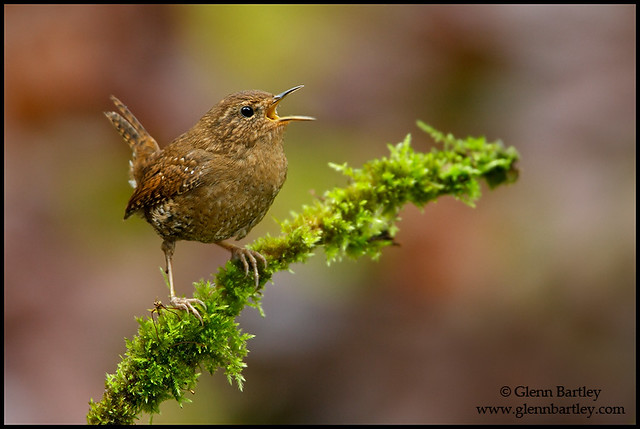
Warblers, wrens, kinglets, and most sparrows tend to conform very nicely to these generalizations regarding songs and calls. Take the vocalizations of the Pacific Wren for example. Their calls are very short, simple and repeated, while their songs are quite complex and can continue for up to 120 seconds (one of the longest wren songs ever recorded).

So what's the purpose of all this singing? The answer, as it often does in the natural world, brings us back to reproduction. Bird vocalizations are better defined as songs when we learn why they are produced. Singing behavior is a product of changes in hormone concentrations due to the lengthening of days. As days get longer in the spring, and the breeding season draws ever closer, the production of sex-related hormones (such as testosterone) spikes, and male songbirds begin singing their heads off every morning on your windowsill.

Calls, on the other hand, are not generally regulated by hormones. Instead they are communication- and coordination-related. Warning calls, contact calls, flight calls, foraging calls, distress calls, alarm calls - all of these sounds are produced for the coordination of behaviors. An alarm call will alert other birds in a flock to a predator. Flight, contact, and foraging calls help birds keep track of one another while moving in flocks (Bushtits for example). Distress calls can coordinate mobbing behavior, deterring predators. In fact, Black-capped Chickadees have been known to mimic the distress calls of other species, inciting more birds to join an anti-predator mob.

Pacific Wrens use songs to defend territories year-round.
Pacific Wren song:

Pacific Wren alarm calls:
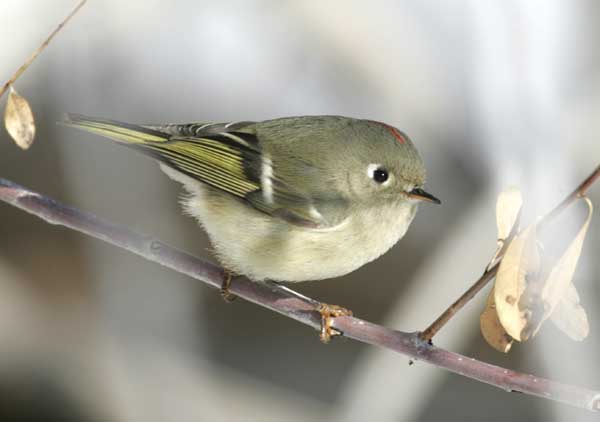
The diversity and repertoires of bird songs and calls is utterly astounding. Every year I hear chickadees, Steller's Jays, Bewick's Wrens and juncos make sounds I have never heard them produce before. I often feel like keeping up with new birdsongs is like trying to keep track of top-40 pop music! For a nice example of how songs can vary within a species, check out the "typical" Ruby-crowned Kinglet songs below.

Learning bird songs is a rewarding and enlightening experience. I have provided a few common songs and calls here to get you started. If you would like to continue your listening lessons, try looking up common bird songs on Xeno-Canto or in the Macaulay Library of Animal Sounds.

Also, it is interesting to note that exactly one year ago today, Dennis Paulson wrote a similarly themed blog entry about the arrival of spring and birds singing and breeding! Funny how the timing of this worked out! Check out last year's blog entry here.


- Robert Niese
Education and Outreach Coordinator

Bushtits use a variety of contact calls to keep track of one
another while foraging in large flocks. Listen to these calls below.
Song Sparrow songs are also quite common in my neck of
the woods. But don't get me started on song-variation in
sparrows. That's a topic for another day. Or week, perhaps.
Here's a typical song for Pacific Northwest Song Sparrows:

And here's a very nice recording of their alarm calls:
In my opinion, Ruby-crowned Kinglets sing one of the oddest
songs in Washington! Each song consists of three parts
 and each of those parts varies greatly between individuals.
Here is a "typical" song for a "Northwestern" Ruby-
crowned Kinglet. Note the three parts. The high-pitched
section, the descending twitter, and the see-sawing warble:

Now listen to how this individual from the Rockies changes his
song. It's different but we can still pick-out the three main parts:

Some birds will rearrange parts of their song, like this one from Quebec:

And then there are oddballs, like this population in British Colombia:

American Robins have remarkably diverse vocalizations.
Here is a typical Robin song:

This is an alarm call:

And here is another call type:
 

Thursday, September 17, 2009

where have all the birds gone?

I have perceived a lack of songbirds lately, and you probably have also. Not only did birds stop singing at the end of their breeding season, but most of them departed for parts unknown.


Where do these multitudes of birds go? You have to answer this question for each species, as each species has its own unique distribution. But we don't know where each individual goes, and when a Barn Swallow flies by me, I fantasize about it carrying a little flag that says "on the way to Bolivia." The great mobility of birds has long been recognized as one of the most characteristic things about them, and they use this mobility to good avail in their annual migrations.

By migrating north in spring, birds that have wintered in the tropics can take advantage of a seasonal flush of food resources, avoid competition with the great diversity of resident species, and get away from the nest predators—among others ants, snakes, kinkajous, and toucans—that are so common in the tropics. When winter comes at our high latitude, and insects and other primary sources of food are no longer available, they return whence they came.


Some of our breeders, for example Varied Thrushes that dig insects from the forest litter and Dark-eyed Juncos that subsist on weed seeds, may winter in the Washington lowlands, just downslope from where they bred. Seed-eating birds such as finches and sparrows often winter quite far north, as there is an abundance of seeds—the plant's dormant stage—at that season. So our backyard winter avifauna features seed-eaters, and many of our breeding sparrows winter not far away, in California and the Southwest.


But the majority of our small birds are insect-eaters. These birds—the thrushes, sparrows, vireos, warblers, tanagers, flycatchers, and swallows—head for warmer climes.
Many birds glean caterpillars and other insects from leaves. Leaf-eating insects become inactive at low temperatures, and leaf-gleaning birds can't find enough food to keep their metabolic furnaces stoked, so off they go. Most of our vireos and warblers winter in western Mexico and northern Central America, as do Western Tanagers, Black-headed Grosbeaks, and Bullock's Orioles.

Flying insects are even less likely to be active during winter, as they need real warmth to be able to fly. So those birds that eat flying insects can't make a living anywhere near these parts, and many of them are long-distance migrants. Western Wood-Pewees and Olive-sided Flycatchers head for the mountains of Central America, Bank and Cliff swallows and Eastern Kingbirds to the Amazon Basin, and Barn Swallows rarely make it all the way to Tierra del Fuego. These are long flights, but ones quite possible to long-winged birds such as swallows.


They’re gone but not forgotten, and they will return. Of course they leave behind many resident birds such as chickadees, jays, woodpeckers, and others, but that's another story.


Dennis Paulson
Nature Blog Network