Showing posts with label owls. Show all posts

Tuesday, January 27, 2015

AN INTIMATE AVIAN EXPERIENCE


For a unique and intimate experience with waterfowl and other birds, visit George C. Reifel Migratory Bird Sanctuary west of Ladner, British Columbia.

Reifel Refuge, as it’s called by many, is a 300-hectare (740-acre) plot of land on Westham Island on the Fraser River, about an hour’s drive from the metropolis of Vancouver. George Reifel bought the land in 1927 and established a family recreational retreat on it, creating waterfowl habitats as well as road access by a series of dikes and causeways.

In the 1960s, the Reifel family granted a lease to the British Columbia Waterfowl Society to create a bird sanctuary on the land. Helped by the management of Ducks Unlimited Canada, wildlife habitat was preserved and expanded with the provincial government establishing a game reserve on adjacent land. In 1972, the family further donated and sold the land to the federal government on the condition that it would be maintained as a sanctuary.

The government designated part of the sanctuary and the area adjacent to it, some 328 hectares, as the Alaksen National Wildlife Area. Some activities are permitted on this land but not the free access to the public that characterizes the sanctuary.

The sanctuary charges a nominal entrance fee and is open from 9 am to 4 pm every day. Sometimes it has quite large crowds, not a place to go if you want to get away from people for your nature experience. However, the high density of humans day after day is what has conditioned the birds to be as unafraid of us as they are.

The sanctuary was set up for waterfowl, and there is always a good representation of local waterfowl species, both dabbling and diving ducks. Large numbers of Snow Geese migrate through the adjacent wetlands, some of them remaining for the winter, and mostly those will be seen overhead moving between feeding areas. All the ducks present are somewhat used to people and will furnish close viewing and great photo opportunities.

There is a small population of resident Sandhill Cranes, most of them not pinioned, and some of them will feed from the hand. Some of them are good at gently taking seeds from an open palm, but be aware that you’re taking the chance of a poke with a sharp beak from those that aren’t. There are also Black-crowned Night-Herons roosting near the entrance to provide good looks at another unexpected species.
There are feeding stations everywhere, and during the winter they attract great numbers of seed-eating birds, for example Black-capped Chickadees, Red-winged Blackbirds, Spotted Towhees, Fox, Song, and Golden-crowned Sparrows, House Finches and House Sparrows. The chickadees are so tame that anywhere along the trails they will land on your hand if you open it with sunflower seeds on it. Occasionally a Red-breasted Nuthatch may do the same.

Brown Creepers and kinglets are also often seen, and like other birds there are quite tame. Quite a few other passerines inhabit the patches of woodland, and unusual visitors are seen with some regularity, for example Bohemian Waxwings and Pine Grosbeaks recently. And it’s always worth watching for less common sparrows such as Swamp, Harris’s, and White-throated along the path.

Because of all the feeders and seeds, rats and mice and Eastern Gray Squirrels (including the black morph, established in the Vancouver area) are also attracted to the area, and the local owls know it. A pair of Great Horned Owls is regularly seen, and there are always Northern Saw-whet Owls present, if very hard to see in the dense foliage where they roost. Other species of owls are seen from time to time, and there are usually hawks and falcons about, interested in the songbirds as well as the rodents.


You can buy sunflower seeds at the office and carry them around to feed to whichever birds you like. You may give them all to chickadees, as there is something wonderful about one of these tiny birds landing on your hand. You may be attacked by Mallards before you barely get going onto the trail, and Mallards are the most abundant and insistent ducks in the place. But look closely, and among the Mallards there will be at least a few American Wigeons and a few Northern Pintails.

More than these, there are Wood Ducks scattered around the area, and they too are interested in handouts if they can get to them before the omnipresent Mallards. They are shy enough that you’ll have to seek them out, but one way to feed them is to put seeds on top of fence posts, which the Wood ducks—tree dwellers that they are—can easily get to. Of course they have to beat the chickadees and Song Sparrows to them.

Dennis Paulson


Tuesday, April 3, 2012

SNOWY OWLS ARE ORNITHOPHAGOUS!


The Snowy Owls (Bubo scandiacus) that came down to Washington this winter, which I have written about before, finally contributed some pellets to the cause of science.

Of course, you know what owl pellets are. Birds of prey, and actually quite a few other birds, eat a lot of stuff that doesn't make it through their digestive tract. Hair and feathers are difficult to digest, as are bones and mollusk shells. So even if they are broken into smaller pieces when eaten and crushed by heavily muscled gizzards, even the smaller pieces can't pass through the hindgut very well. Rather than sharp-pointed bones coming up one by one, they are coated in hair or feathers and barfed, urped, hurled, vomited and/or regurgitated back into the environment.

It's not easy to find these pellets unless you know right where the bird has been roosting. After they are produced, they get covered up by detritus, even blown around, and eventually decay into pieces. But they hold together for a while, and ornithologists have long used them to get a handle on the diet of birds such as hawks and, especially, owls. Snowy Owl pellets look like fuzzy three-inch cigars. It's been said there is nothing like a good cigar, but I personally prefer owl pellets.

Paul Bannick, well-known bird photographer and author of The Owl and the Woodpecker, recently sent me three pellets he picked up from one spot at Ocean Shores. At the museum, we soaked them in water and stirred them up until the feathers floated and the bones sank. We recovered a surprising amount of bones, arranged them by type, and identified them by comparing with our skeleton collection.

I had a pretty good idea what birds were out there, and it wasn't difficult to identify the majority of the bones as sandpiper bones. The only confusion would have been between Sanderling and Dunlin, both common birds in Grays Harbor. Sanderlings were common right where the owls were roosting, so I favored them. Sure enough, there were several lower mandibles present, and they clearly belonged to Sanderlings.

In total, at least five Sanderlings were present in these pellets, as indicated by counts of tibiae and tarsometatarsi, long, slender bones that were well represented because birds of prey tend to swallow legs of smaller birds whole. In addition to all the sandpiper bones, there were quite a number of larger bones. Many of them were broken up, but a few were intact, and two coracoids and a femur allowed identification as a Horned Grebe. Probably all the bones, including many vertebrae, were from the same bird.

I also examined single pellets from Sandy Point, near Bellingham, furnished by Isa Werny and Andrea Warner. They were mostly feathers, but one of them contained a few Horned Grebe bones, the other a few Bufflehead bones. The second pellet was found at the foot of a utility pole along with parts of a dead Bufflehead, making the identification easier. Both of these species are known Snowy Owl prey.

Snowy Owls are well known to subsist largely on water birds in the winter on our coast, and there wasn't a trace of a mammal in these five pellets. By now you may have figured out that ornithophagous = bird eating.

Dennis Paulson
Thursday, January 5, 2012

SNOWY OWL FLIGHT YEAR


The winter of 2011-2012 will go down in history as a time when arctic-breeding Snowy Owls (Bubo scandiacus) came down in great numbers to southern Canada and the northern United States. This happens at irregular intervals, and this time it has been six years since the last flight year in the Pacific Northwest.

These flights are called irruptions, a word meaning 'into an area' just as eruptions means 'out of an area.' The latter is used for volcanoes, the former for unusually large flights of birds or movements of other animals, usually detected where they arrive. In this case, our baseline is no more than a few birds observed each winter, whereas the irruptions involve dozens to hundreds of birds.

Snowy Owls have been reported from many localities since November, some of them birds that were seen for only a day or two, others birds that arrived and stayed put. Numbers inland are generally small, not much higher than in non-flight years, but the majority of birds are congregated near the coast.

Up to a dozen birds have been present on Damon Point, a spit on the north shore of the entrance to Grays Harbor, and these are the birds featured here. Even more are present along Boundary Bay in southern British Columbia. At both of these localities, numerous birds can be seen from the same spot, sometimes several perched together on a log. They seem not at all aggressive to one another. In addition, a few birds have taken up residence at Port Susan Bay and the Nisqually Flats.

There is still some confusion about exactly why the owls come down in numbers only at intervals. Earlier thoughts were that they did so after a lemming population crash, the absence of their primary food sending them south. But this has never been entirely satisfactory, because lemming population cycles in different regions are independent of one another, yet the irrupting owls appear over a very wide area.

An alternative gaining more credence is that during years of lemming population highs, the owls do very well, and so many young are produced that densities in the fall are higher than normal, and this sends many birds southward or perhaps in all directions. Thus our numbers are because of lemming booms, not lemming busts.

Lemmings are absent from this area, but voles are locally abundant, and some of the birds that make these flights may subsist on these lemming relatives.

In lieu of these rodents, many owls switch to a water-bird diet, which is why coastal areas are favored. Water birds usually roost right out in the open, either on shore or on the water, and if the owls go out at dusk to hunt them, their prey is at a great disadvantage. A white owl approaching in low light levels may be just about impossible to see against a paler sky. We still don't know if they continue to hunt through the night, but they clearly don't during the day, which is why we rarely see them doing anything but turning their heads and occasional preening.

Studies based on the collection of regurgitated pellets find these coastal owls eating shorebirds (Dunlins, Sanderlings, Red Phalaropes) and diving birds (Horned Grebes, Buffleheads) as well as Black Rats that live among jetty rocks. After the breeding season, some female owls fly out to the pack ice and presumably have nothing to eat but water birds.

One last thought. These owls are magnificent additions to the local scene whenever they favor us by their presence. Although they seem tame and placid, it's always best to avoid getting too close. Each owl has its own flight distance, and observers and photographers should be sensitive to that.

Dennis Paulson

Wednesday, November 30, 2011

RAPTORS IN THE CITY

One of the surprises in studies of urban wildlife in recent years is the invasion of our cities and suburbs by predatory birds such as hawks and owls. Perhaps "invasion" is too active a word, and a better word is "acceptance." More and more raptors are apparently becoming comfortable with living in the cities of the Pacific Northwest and, in fact, all across North America.

Bird feeders have become a dependable part of the urban/suburban environment, and many small birds are attracted to them. The juncos and finches and sparrows that abound at feeders attract Sharp-shinned Hawks in winter, but the hawks leave for the mountains in spring. However, their larger relatives Cooper's Hawks are year-round residents, feeding on pigeons, jays, and flickers and nesting in wooded areas that give them a sense of security. The males are conspicuous in spring, with display flights and vocalizations, so more and more of them are being detected living among us.

Merlins too are in the process of becoming city dwellers. These small falcons nest in forests near open country, where they usually capture their prey (small birds). Wintering Merlins probably moved into cities to take advantage of local concentrations of small birds, and eventually pairs remained throughout the year and nested because of that prey abundance. Their nesting efforts have been successful, and the population of urban-nesting Merlins has slowly risen.

Barred Owls have moved into the Pacific Northwest from the north, and they too appear to be comfortable in wooded parts of our cities. Preferred prey include the gray squirrels and rats that have been introduced into the region, and our bird feeders attract and concentrate these mammals as well. There are now pairs of Barred Owls, Cooper's Hawks, and Merlins nesting in wooded areas near my house in Seattle that weren't there 10 years ago.

Red-tailed Hawks do not live around dense housing developments, but large parks and open spaces furnish adequate hunting grounds for rats and squirrels, and if any trees in their territory are large enough to support their nests, they may nest in our cities. Many more of them appear in winter to hunt in open areas around parks and airports.

The Great Horned Owl is a top predator surprisingly willing to live in cities, mostly in relatively large parks. It is large enough and fierce enough to handle mid-sized mammals such as raccoons, opossums, and domestic cats that thrive in cities. Crows and pigeons furnish abundant prey populations as well. Nest sites (usually old Red-tailed Hawk nests) may be limiting, however.

Even more surprisingly, after a long period of decline during the DDT era, Bald Eagle populations have rebounded in the Northwest, and they not only visit but even nest in the cities, often in large parks near water where prey species such as waterfowl and fish are available. They need large trees for their huge stick nests.

Whenever a shift like this occurs, it is worth trying to distinguish between behavioral adaptation and genetic adaptation. Have these birds "learned" that cities are OK? Or are there genes for city living that have become favored? Are there genes for increased tameness, recognition of bird feeders as sources of bird concentrations, resistance to being mobbed by crows? Actually, cities aren't bad places to live for mobile predators such as these, as there may be local sources of abundant food and some of their own potential predators may be absent. Also, the first individuals to accept life in the cities have no competition from others of their species!

Dennis Paulson

Friday, October 28, 2011

A HALLOWEEN TREAT

A spooky Halloween story or chilling thriller film is incomplete without the appropriate array of creepy nighttime animal sounds. Unfortunately, many an evening stroll has been transformed into a terrifying, heart-pounding experience thanks to these bloodcurdling calls. In fact, we can encounter a variety of these sounds right here in the Pacific Northwest! And because we only fear what we don't understand, here is a brief guide to the spookiest of our local animal sounds to help you learn more about these relatively harmless creatures.


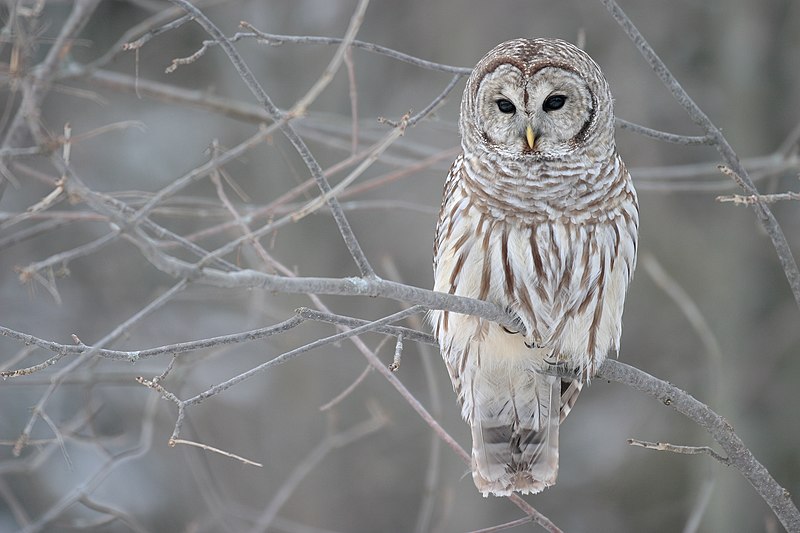
Barred Owl - Strix varia   L: 21"
Common, year-round resident of the Puget Sound region. Often found in mixed coniferous-deciduous forests and seen during daytime hours near roosts. Calls include very loud hooting/barking, often described as monkey-like sounds. Individuals may also hiss or cackle.

Listen


Boreal Owl - Aegolius funereus   L: 10"
Uncommonly seen inhabitant of montane forests in Eastern Washington. Found in mixed coniferous-deciduous northern forests. Call is a series of low, piping hoots that rise and fall in pitch and intensity. Also gives a low, nasal hooAh as well as short screeches.

Listen


Great Horned Owl - Bubo virginianus   L: 22"
Fairly common and widespread, inhabiting a variety of habitats including forests, deserts, tundra, and urban areas. Often seen perched at dusk or mobbed by small birds in the daytime. Call is an iconic series of rhythmic hoots associated with most midwinter forest settings.

Listen


Western Screech-owl - Megascops kennicottii   L: 8.5"
Common in wooded to sparsely wooded areas including urban parks, native woodland, and deserts. Generally roosts in very dense, dark areas and is difficult to see in the daytime. Call is a series of accelerating, abrupt whistled hoots that ends slightly lower in pitch.

Listen
(Can you hear the coyote in the background?)


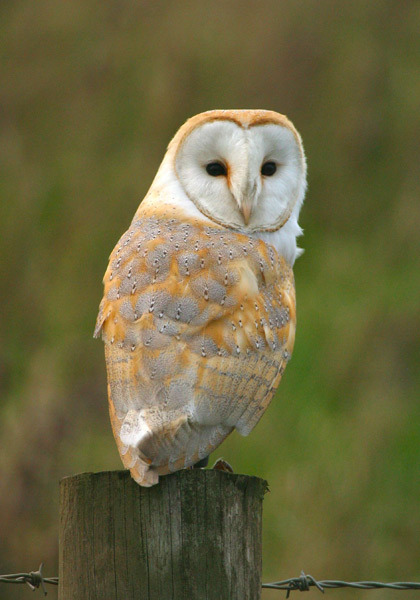
Barn Owl - Tyto alba   L: 16"
Extremely widespread species common to Western Washington. Prefers open grassland habitat and roosts in cavities or human-made structures. Populations may be in decline. These birds do not "hoot" like other owls. Calls generally only a shrieking screech. Very commonly thought to be a frightening, ghostly critter, but its silent flight and phenomenal hearing make it one of nature's best mouse-exterminators.

Listen


Northern Pygmy-owl - Glaucidium gnoma   L: 6.75"
Widespread in coniferous forests throughout Washington. Some may migrate to lower elevations in winter months. Call is a regular, repeating series of tooting hoots. Listen for these distinctive calls at dawn and dusk.

Listen


Coyote - Canis latrans   L: 45"   H: 24"

Common throughout a variety of habitats, especially open areas and clearings. They have adapted well to the presence of humans and have expanded their ranges since the disappearance of the Gray Wolf. Sounds include yips, yaps, whines, barks and bone-chilling howls.

Listen (yips, yaps, barks, howls)
Listen ("moonlight howl")

 
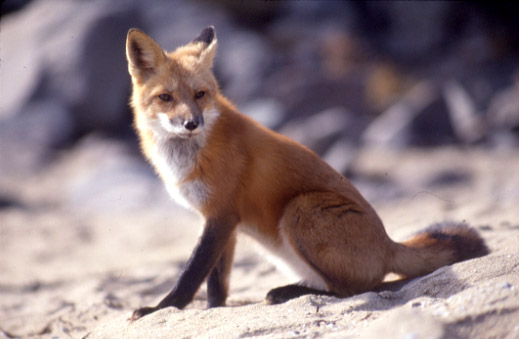
Red Fox - Vulpes vulpes   L: 40"   H: 15"
Prefers brushy open habitats throughout Washington, but generally avoids densely forested areas and higher elevations. Varies in color from black to gray-brown. Sounds include barks, whines, wails and a fairly frightening scream (see video below).
 
Listen


-Robert Niese
Education and Outreach Coordinator

Tuesday, March 22, 2011

THE BIRDS THINK IT’S SPRING

This is the time of year when our resident birds begin to sing. Already I have heard Anna’s Hummingbird, Bewick’s Wren, American Robin, Varied Thrush, European Starling, House Finch, Song Sparrow, and Dark-eyed Junco singing around my house. On the other hand, the vast majority of migrant species have not arrived yet, and those residents that are singing won’t be breeding until some time in April.

Why don’t all birds breed at the same time? Well, an easy explanation for raptors is that their incubation periods are long, so it behooves them to breed before many other species, so they have eggs hatching at a time when food resources are high. As it turns out, the eggs of the early breeders hatch at a time when many local mammals are weaning young.

Some species, for example raptors such as Barn and Great Horned Owls and Red-tailed Hawks, have already begun their breeding cycles. A Northwest pair of Red-tailed Hawks could have a complete clutch of three eggs laid by March 20. The first egg would hatch in mid April, and young would be ready to leave the nest by the end of May.

The bird-eating accipiter hawks (Cooper’s, Sharp-shinned) begin to breed later than the mammal eaters, because the supply of naïve young birds doesn’t really kick in until May or June. A Cooper’s Hawk pair that lays the first egg of a clutch of four on April 15 would expect the first young to hatch on May 20 and the first young to fledge about a month after that. By the end of May there are great numbers of young, naïve birds in the surrounding woodland that can provide prey for a family of Cooper’s Hawks.

A Barn Owl that laid her first of six to eight eggs on March 10 would see the first young hatch on April 10 and fledge in about two months. By hatching time, great numbers of young voles would have emerged from their grass nests to forage in their myriad runways, and the parents can find plenty of protein for their growing young. Furthermore, a just-fledged owlet should have no trouble detecting and catching those furry snacks.

Mammal-eating owls such as Barn and Great Horned breed early, but insect-eaters such as Western Screech and Burrowing Owls breed later for two reasons. First, incubation and fledging periods are shorter for smaller birds, so there is no reason to start so early. More importantly, their prey does not become active until ambient temperatures allow activity. So these owls are laying their eggs in April and even May.

A Burrowing Owl clutch of eight eggs might be completed on April 15, when incubation would ensue. The eggs would hatch around May 15, and the young would be ready to leave the burrow by the end of June, when insects and lizards abounded in its nesting territory.

So the eggs of the mammal eaters hatch about a month before the eggs of the bird and insect eaters, just as predicted. Not only the wonderful adaptations of living organisms, but also their exquisitely fine tuning, never fail to impress me.

Dennis Paulson

Tuesday, January 18, 2011

THE HAWK OF THE OWLS

When you first encounter a Northern Hawk Owl (Surnia ulula), you will understand why it has two different types of raptors in its name. Clearly an owl because of that big head and forward-facing eyes, nevertheless it has the rakish look of a hawk about it, with long tail, rapid flight, and – of course – diurnal habits.

One of these birds spent the winter of 2010-2011 on Westham Island in southwestern British Columbia, delighting birders and nature photographers by the hundreds. Because of their open perching habits and tameness, Hawk Owls are readily detected where they occur, so it is likely that at least some of the few individuals that make it to peripheral wintering areas are found as observers scrutinize the winter landscape. In my case, it was a wonderful way to start the year - and on a beautiful sunny day!

In the Pacific Northwest, we don’t get veritable invasions in winter, with dozens of Hawk Owls showing up like they do in the Great Lakes region. Nevertheless, at least a few birds make it down to Washington in most winters, and with increasing knowledge of where to look for them, more have been seen in recent years. Breeding has been confirmed at Manning Provincial Park, just north of the border in British Columbia, and suspected at Harts Pass in Washington.

Hawk Owls perch, usually at the very top of a tree or other conspicuous perch (often on utility wires in this day and age), and survey the surrounding semiopen landscape for their prey. Their primary prey is voles, but they are willing to take anything they can subdue from a long list of mammals up to the size of hares and birds up to the size of grouse.

Hawk Owls are not modified like many other owls for auditory hunting. Their two ears are symmetrical, and they don’t have a well-developed facial disk. They must have good hearing, however, as they are occasionally seen to plunge into snow to capture a vole. With long tail and short, rounded wings, they hunt somewhat like accipiter hawks, detecting prey visually and dropping from a perch to move at high speed with rapid wing beats. Most prey is captured at fairly close range, but their distant vision is excellent.

There are other diurnal owls. Most pygmy-owls hunt during the day, small birds their primary prey. Snowy Owls and Burrowing Owls are conspicuous features of open landscapes, although both hunt at night as well. Short-eared Owls can be seen during the day, but much of their hunting is at dusk. The same is true for Great Gray Owls. Hawk Owls, conspicuous on their perches all day long, also tend to hunt more in the afternoon, so hunting in dim light seems to be hardwired in owls.

Bear in mind that owls of the Far North must be able to hunt both day and night, as the days are so long in summer, the nights so long in winter. Fortunately for them, voles are active day and night.

Like many other owls, Hawk Owls nest in natural cavities, for example at the hollow tops of broken-off snags, and holes abandoned by woodpeckers. Their clutch size varies from 3-13 eggs, with a mean of about 7. It is a large and variable clutch size, as is the case with several owl species that seem to depend on voles and lemmings for their reproductive success.

Keep your eyes peeled for the owl that acts like a hawk!

Dennis Paulson
Nature Blog Network