Showing posts with label parental care. Show all posts

Wednesday, June 8, 2016

THE ANGELIC AND DEVILISH PIED-BILLED GREBE

Pied-billed Grebes, Podilymbus podiceps, breed at several lakes within the city of Seattle and doubtless within many other cities in the Pacific Northwest. One of our breeding sites is Magnuson Park, where one or two pairs of grebes began to breed just last year at the Shore Lagoon, the pond closest to Lake Washington. The male started calling early this spring.


And in mid May I saw the adults taking care of 5 downy young. They are very striking, with their striped heads and reddish markings. The young grebes have a strong predilection for riding on the back of the female, and I saw this numerous times. Four young at once would try to crowd onto her back, a logistical impossibility, but I saw her holding three on a few occasions. As they got larger, of course, this behavior became less likely. But it was very cute to see, a picture of parental care in a bird that can't be beat.


For several years this pond, the result of a wetland mitigation, had no fish in it. Last year the grebes fed their young primarily large dragonfly larvae, and these common insects were apparently sufficient food for the family. By this summer, Oriental weatherfish, Misgurnus anguillicaudatus, an introduced member of the loach family, had found their way into the pond somehow, perhaps through a drain into Lake Washington. So they have been the hot items on the diet this summer.


The young laze around until an adult comes up with a fish, then immediately crowd in. At first the loaches were too large, and I saw the female attempt to offer them to one young after another with no success. They swallow their food whole, so this wasn't doing it, and I assume there must have been smaller food items fed to the young when I wasn't watching. There were originally five young, but two weeks later I could see only four, so a predator may have taken one. A young bird that fledges may have moved from one narrow escape to another.


However, these grebes, especially the male, dominated the pond. He would call often and loud, sounding like a challenge to me. One day I saw something I wish I had been able to photograph. Two Mallard ducklings were following their mother across the pond, when one of them disappeared. I wondered if someone had introduced a large bass or snapping turtle into the pond, when a few seconds later the male grebe surfaced right at that spot. I didn't see the duckling again, and 10 minutes later I found it floating dead on the surface, with wounds on its head.

In additional visits, I saw the grebe chase both ducklings and adults ducks numerous times, and one of my friends saw the grebe kill two ducklings in a row. The literature about Pied-billed Grebes makes it clear that they are fiercely territorial against each other and other water birds, and a case of a Pied-billed killing the chicks of a Least Grebe was reported. The male that I watched regularly was astonishingly aggressive, chasing every bird that it came near, and I started calling it the Devil Grebe. Of course it was just exercising normal behavior for the species, and it's not the only water bird that has been reported to kill the chicks of other species. Nature is something else.


Dennis Paulson

Tuesday, September 10, 2013

THE SHOREBIRDS ARE BACK


In fact, southbound migratory shorebirds have been back in the Pacific Northwest since the last week of June, but it is timely to write about them, as they are probably at their peak at the beginning of September.

The adults come back as soon as their young fledge, but of course some nests fail, and those adults are the first to return. Why stay in the Arctic, with all those mosquitoes and arctic foxes, when where you really should be is on a mud flat in Grays Harbor or a sandy beach in Sinaloa? Some of them are going farther, well into South America, so they had better get an early start for that long flight.

In quite a few shorebird species, one sex deserts the other adult and the offspring soon after the eggs hatch. The majority of these are females, presumably because females have expended much energy producing the eggs, so to balance parental investment, the males are left to raise the young. Most shorebirds don’t feed their young, so raising young shorebirds consists of shepherding them around to feeding sites and warning them about potential predators. It’s still a lot of work (imagine keeping track of four kids when you can’t see them much of the time).

Perhaps because they are big enough to potentially ward off predators, large shorebirds such as curlews and godwits divide parental responsibility, and the sexes migrate together. This is also true of most plovers. But the first Western Sandpipers you see in fall are probably those that failed at nesting, then a large wave of females that have left their families, then the males.

Many of these species undergo body molt while they are migrating, so in the fall we see birds in breeding plumage, in nonbreeding plumage, and at all stages in between. In addition, another plumage complicates the issue. These are the juveniles, young of the year that migrate after the adults. The peaks of their migration are often about a month apart, so in some species that continue south after passing through our region, we see a lot of adults and then a lot of juveniles, but not much mixing.

When trying to identify unknown shorebirds, it is extremely important to place them in a plumage, or at least an age stage. In fall, the adults have very worn body feathers until they are all replaced, and many of them don’t replace all their feathers until some time in the winter. Of the flight feathers, both the primaries and the tertials (the feathers of the inner wing that cover the primaries when the wing is folded) become very worn, and that wear is easily seen. Juveniles, on the other hand, have neat unworn feathers, including the primaries and tertials.

Get out to the coast and savor the shorebirds. You can easily see one to two dozen species on a good day, and identification is much facilitated because they are often in mixed-species flocks.

Dennis Paulson

Tuesday, July 9, 2013

“TIS THE SEASON TO EAT DUCKLINGS,


Fa la la la la, they’re good for you.”

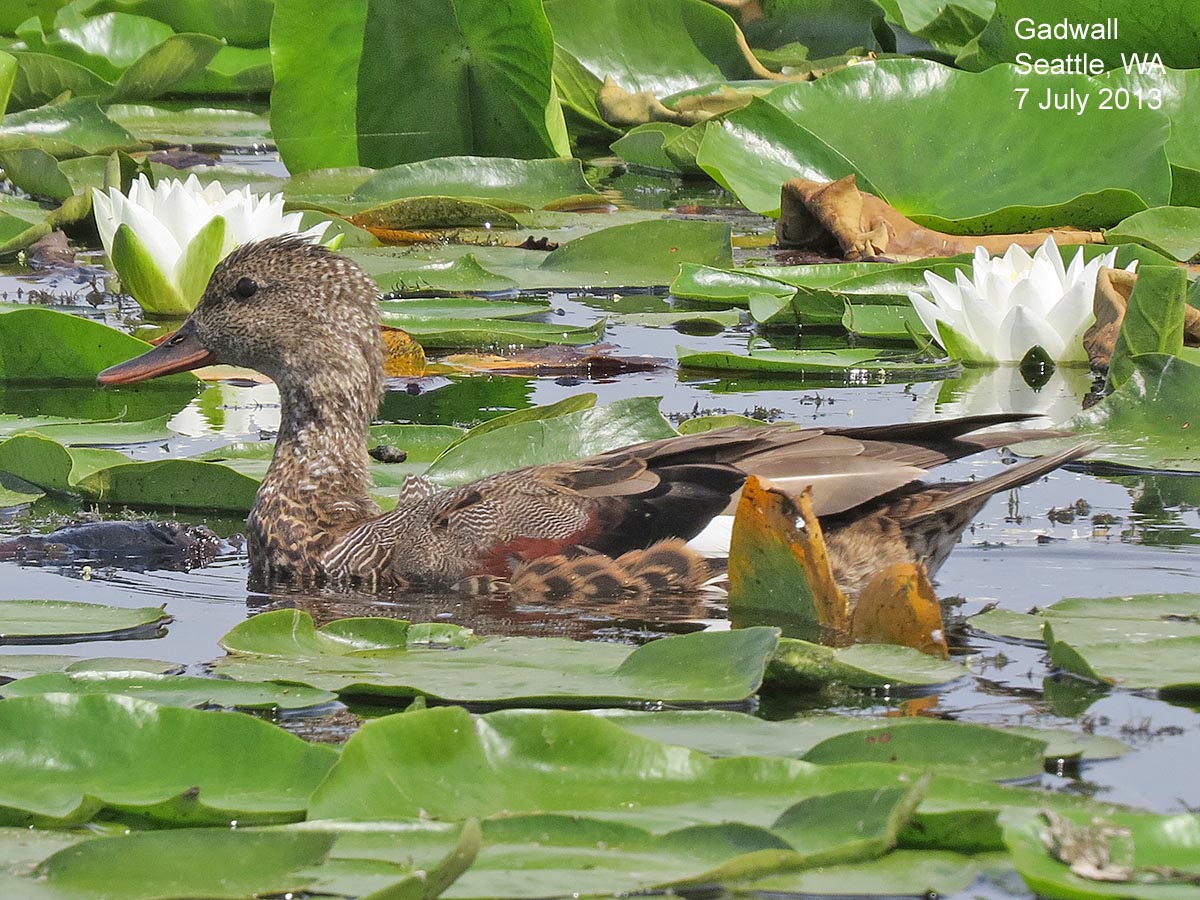
This just might be the spring song at the top of the Coyote Hit Parade. Ducks have been breeding for the past several months in the Pacific Northwest, and there is a steady supply of cute, fuzzy, edible ducklings. Mallards were first, and many of them have full-sized young now. They were followed by other species, including Gadwalls, the second most common breeding duck in western Washington.

Ducks lay clutches of around 8-10 eggs and incubate them for almost a month to hatching. Incubation begins when the last egg is laid, so the young all develop synchronously and hatch at about the same time. The female leads the ducklings from the nest off to a good wetland feeding area, watching carefully for predators.

She can warn her offspring to hide, but she can’t do much to protect them against the predatory mammals, birds, snakes, frogs and fish that might relish a duckling meal. A duckling might be a snack for a Coyote, a good lunch for a Mink, or an overstuffed belly for a Bullfrog.

The downy (cute) stage in a Mallard lasts about 25 days, and then they begin feathering out and enter their gawky “teenager” stage.  After another few weeks, they are fully feathered, and they can fly at around two months of age; most broods are abandoned by the female then or a bit before.

Males of most species of ducks desert their mates when incubation begins, but in city ducks, it seems that more and more males can be seen with their families, at least early in the season, and one wonders if there are genetic changes happening in these populations.


The males begin to molt out of their definitive plumage soon after leaving the females, changing to a female-like eclipse plumage and eventually molting all their flight feathers simultaneously. The Gadwall shown here is entering that plumage. After their brood has fledged, females also undergo a complete molt, although they don’t change plumage.

Meanwhile, predators are taking their toll. Rarely will you see a complete brood of ducklings. Instead, the numbers decrease week by week until there are often only a few left with any given female. Sometimes females combine broods, raising the level of predator awareness with two pairs of eyes, but the young still remain relatively unprotected.

In any case, all a pair has to do is raise two young successfully in their lifetimes to keep populations stable. Waterfowl populations as a whole are doing well, so those females must be doing something right! Perhaps it’s good that not all those ducklings survive, as wouldn’t we be knee-deep in ducks at some point?

Dennis Paulson

Friday, October 19, 2012

EXTENDED PARENTAL CARE IN BIRDS


You may be surprised to see obviously immature (brown) gulls at the waterside at this time of year vigorously begging from some nearby adult. You can recognize begging by the bird's throwing its head back and giving loud, high-pitched calls. You may be even more surprised to know that the adult isn't necessarily the parent of that young bird. You may not be surprised to see that the adult ignores the young or chases it away if it remains persistent.

This begging behavior continues into the winter and even to the next spring in some Glaucous-winged and Western Gulls and their hybrids. After all, they have begged for food from their parents for several months, and the behavior is hard to turn off—especially if they are hungry!

Extended parental care after the young have left the nest area is rather rare in birds and seems to be restricted mostly to fish-eaters. It is not easy to catch fish—no bird has evolved a rod, reel, hook and line for the job—so a young bird just starting out to learn how to do this may have a difficult time of it. So although we see these gulls trying to get a little extra parental care, they don't usually get it.

However, young of some other types of birds are successful beggars well after the breeding season. Several species of crested terns have extraordinarily long dependence on their parents after fledging. Juvenile Elegant Terns fly around with their parents for up to six months or more, beg from them, and are fed.

Juvenile frigatebirds may return to their nesting colony for as long as a year after leaving the nest, to be fed by one or both of their parents. Frigatebirds forage by capturing squids and flying fishes at the sea surface, and they have to be very effective at scooping one of these fast-swimming fish from the water. Thus it takes a long time for the young birds to be effective foragers.

Tropicbirds also feed in the open ocean and on the same types of fishes and squids as frigatebirds, although they plunge into the water at high speed to capture them rather than picking them up with a long bill. Interestingly, tropicbird parents do not feed the young postfledging. Perhaps they should, as frigatebirds are thought to have low juvenile mortality for a seabird, presumably because of the extra help they get from their parents.

Dennis Paulson
Nature Blog Network