Thursday, November 11, 2010

DUCK MATING GOES ON AND ON AND ON

It’s nowhere near spring, but believe it or not, there are many Pacific Northwest birds in the throes of intense mating behavior. Those birds are ducks. Ducks have a peculiar mating system, unique among birds. They form a strong pair bond, but it is mostly during the nonbreeding season!

Males of most temperate-zone ducks have bright, species-specific plumages, quite different from the drab plumages of females, many of which look very similar to one another. But these bright feathers are displayed from fall to early summer, and they are replaced during midsummer by a dull, female-like basic plumage (often called “eclipse” plumage). Displaying “breeding” plumage in fall, winter and spring and “nonbreeding” plumage in summer seems quite reversed from the situation in other birds, and in fact it is.

Most temperate-zone ducks are migratory, moving from breeding grounds in marshy freshwater wetlands to larger ponds and lakes and the ocean itself after breeding. Some duck species arrive on their wintering grounds while still in basic plumage, and the males molt fairly quickly into their beautiful alternate plumage. Other species, later migrants, molt farther north and arrive already in full color.

Almost as soon as the flocks arrive on their wintering grounds, the urge to mate kicks in, and the males begin to court the females. Those that arrive early wait until they have molted, but those that arrive late can begin the process immediately. Male ducks all have distinctive displays, which, coupled with their bright, species-specific colors, produce a dazzling show. Behavior involved in mating, both aggression and courtship display, is at its best in groups, with multiple individuals of both sexes.

Most male dabbling ducks have bright, contrasting markings around the head and breast and additional bright markings around their rear end. As soon as you see them display, you realize these color patterns are incorporated into the display. The displays are quite stereotyped, male Mallards, for example incorporating distinct display behaviors called Grunt-Whistle, Head-Up-Tail-Up, and Down-Up. Distinct behaviors are usually capitalized when written about in scientific literature.

Female Mallards perform head movements, bill-jabbing behavior, and characteristic vocalizations to indicate interest in copulating with a particular male. Females of most species will show aggression to males other than their mates. Copulation between pairs starts in the fall and continues through the winter into spring, when the birds return to their breeding grounds. Maintaining the pair bond seems to be the important function of this activity, which of course does not result in eggs being formed.
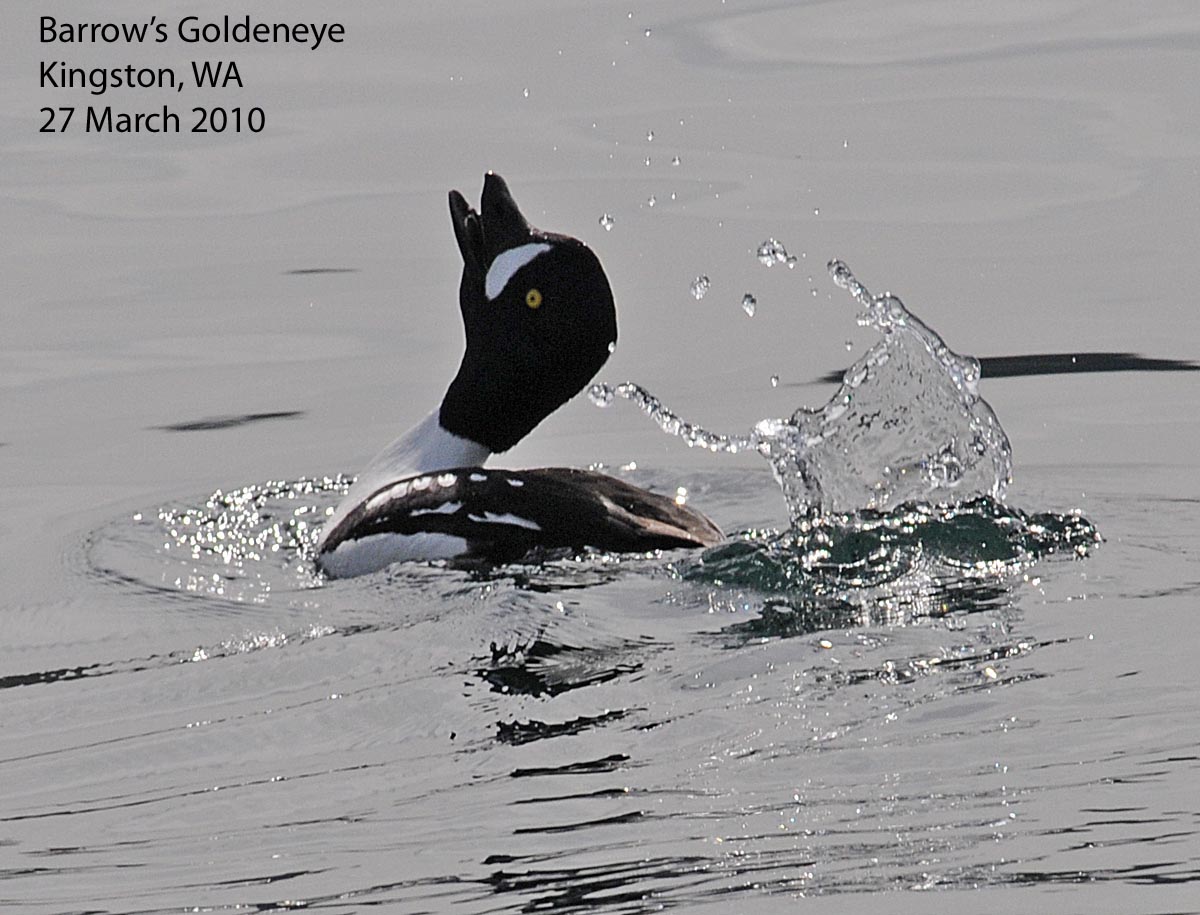
Displays in goldeneyes and mergansers are among the fanciest. In male goldeneyes, the head is thrown back almost onto the back, with a big splash when the feet kick back and an accompanying throaty note. In Red-breasted Mergansers, the male ends its display with tail down, back up, breast sinking into the water and neck extended upward with open beak, the whole thing reminiscent of some reptilian ancestor.

Some ducks rush along the water or fly short distances in their courtship. Buffleheads bob their heads violently up and down, fly just over the female and land by skiing on their bright pink feet, and cock both wings forward, exposing their big white patches. As part of their display, male Black Scoters also rush along the surface but with head down. A male Surf Scoter flies for 20-30 feet, wings whistling loudly, then drops feet-first into the water with wings raised. These display components are stereotyped in form and the order in which they are presented.

Because there is heavier predation on females when they are nesting, there are more male than female ducks in winter. Thus by spring there are still many unmated males. Courtship becomes even more intense, as gangs of male ducks roam around trying to find unmated females and spending much time harassing pairs to try to separate them (usually unsuccessfully). A lone female may be harassed by numerous males, and forced copulations are common at that time.

Finally, it’s time to make something of all that time spent mating. The pair heads off to wherever it is they breed, still maintaining that bond. They arrive, and the male has a fresh bunch of rivals to deter. The female quickly constructs a nest and lays her clutch of eggs, all the while shadowed by her mate. As soon as she begins to incubate, he leaves the scene and begins to hang out with other males in the same state. They typically move out into deeper water, begin their molt into basic plumage, and drop their flight feathers in preparation for growing a new set. It’s a new year in the odd annual cycle of a male duck.

Dennis Paulson

Thursday, October 28, 2010

THE SNOW GEESE HAVE RETURNED

Here it is late October, and the Snow Geese (Chen caerulescens) have made their annual transhemispheric trip from Wrangel Island, off the north coast of Siberia, across the Bering Straits and down into North America. Up to 100,000 or more birds are thought to make this journey, without a doubt the largest crowd of emissaries from Russia to the United States. Forty thousand pairs are thought to breed on Wrangel Island, and they bring with them the young produced each year.

Half of these birds remain for the winter in the Fraser River and Skagit River valleys of southwestern British Columbia and northwestern Washington, the other half continuing down to major wintering grounds in southern Oregon and California’s Central Valley. Many of the birds have been banded on Wrangel Island, and they bear conspicuous numbered plastic neck collars.

This migration, of very large numbers of birds moving from restricted nesting grounds to restricted wintering grounds, is typical of geese, which seem to function best in a highly social setting. They are herbivores, grazing on grasses and forbs in open areas, and there is usually more than enough food for all. If you’re a herbivore, the world is your breakfast (lunch, dinner) table! Especially if you can eat just about any kind of herbaceous green plant.

These large groups of geese probably facilitate mating (the young birds are surrounded by potential mates) and predator awareness (how could a potential predator sneak up on such a large number of eyes and ears?). The major predator of the Skagit Valley geese is the Bald Eagle, but predation is infrequent. Eagles probably get mostly sick and infirm birds, the ones that don’t make it into the air when an eagle flies over and flushes an entire flock (which may include thousands of birds).

On the nesting grounds on Wrangel Island, Arctic Foxes take their toll. But the greatest mortality source of our Snow Geese may be from hunting on their winter grounds. Birds wounded but not killed by shot probably fall victim to eagles and possibly other predators such as Coyotes. Nevertheless, hunting is strictly regulated and has negligible effect on the goose populations.

The average clutch of Snow Geese is about four eggs. Of them, 80% reach hatchling stage, and 75% of those reach fledging. Thus each pair of adults should produce on average about two young each year. Without heavy mortality, this would lead to a population increase, and that in fact is what is happening with Snow Geese throughout most of their range, leading to conservation and management problems. The widespread availability of agricultural land in winter and the opportunity to expand to new nesting areas in the Arctic combine to enhance population growth. The Wrangel Island population is an exception, having been stable in recent years.

Many immatures are evident in the Skagit flocks, in their distinctive gray plumage. The immatures attain adultlike plumage by the time they are one year old but do not breed until they are three years of age. The birds are censused annually, and the percentage of immatures in the wintering population is an easy way to measure breeding success in the previous summer. Young birds of this population pair during their third winter, and the pair stays together until one of them dies; life span may be two decades or more.

The Snow Geese of the Skagit Valley provide one of the most spectacular of wildlife spectacles in the state. Throughout each winter, carloads of people stop in designated parking areas and watch flocks, sometimes immense flocks, of the geese feeding and flying at pointblank range. They are surely the envy of groups of hunters waiting in vain in nearby fields with their “flocks” of decoys. The birds move between feeding areas, so there are often birds in the sky coming and going.

To see a V-formation of Snow Geese approach from high in the sky, then drop toward the ground by dumping air from under the wings, some of them even briefly upside-down, furnishes a thrill for all who are watching. At the last moment of their descent, the birds extend their webbed feet and spread their tail, as if putting on the brakes, flap vigorously, and settle to the ground. Heads down, they move slowly forward, biting off grass blades as they go. Grass is planted in wildlife management areas set aside for the geese.

These flocks should be checked for the so-called blue morph, previously thought to be a different species, the “Blue Goose.” This morph is common in the central Canadian breeding populations that winter in central United States but has always been rare in the Pacific Northwest. Apparently a few such birds have found their way into the Wrangel Island population, and we see them every winter. They are easily recognized by their dark body and white head; the immatures are much darker than typical Snow Geese.

Dennis Paulson

Thursday, October 21, 2010

BIRD FEEDING – SHOULD WE DO IT?


In North America, more people feed birds than ever before. The number of bird feeders is surely in the millions all across the continent. In some urban and suburban neighborhoods, it seems as if most yards have a feeder or two. However, any quick survey will show that some of them have not been recently replenished. Bird feeding has its aficionados, but not all of them are passionate about it.

So many people feed birds that a cottage industry of feeders and food types has sprung up. A trip to the nearest Wild Birds Unlimited store will make that clear. Seed feeders are among the most common, with a wide variety of seeds, especially millet and sunflower seeds. Look at the ingredients of a bag of some of the fancier seed mixes sometime to see the breadth.

Suet is another ingredient in the cuisine served in many a yard. This fat-based item has always been especially favored by birds during the low temperatures of winter, but there are now many “no-melt” types that provide food during the heat of summer as well. You can get suet now with just about anything in it, from raisins to insect parts. Suet diversity follows the evolutionary pathway common to all of our consumer items, although it’s not clear how much difference all these additives make to the birds.

Presumably most people who feed birds are sympathetic to animals and nature, and surely the majority are environmentalists. But as such, shouldn’t we be thinking about what effects we are having on the birds and the environment? What are the pros and cons of bird feeding?

It strikes me that there are really two positive aspects of bird feeding. First, we are supporting bird populations (or at least individual birds). This is probably not very important during the summer or at any time when there is plenty of natural food available. Most birds live in places that furnish sufficient food and adjust their migratory behavior to the availability of food.

But there is always the possibility of unusually hard times, when weather phenomena make food suddenly more difficult to obtain. The most obvious example of this would be a heavy snow storm, blanketing the ground and all the potential food on and in it. Think of a finch eating weed seeds or a jay digging up cached acorns. Suddenly, these resources would be unavailable, and the presence of a dependable bird feeder could make all the difference between life and death. This could be called “bird benefit.”

The other important positive aspect of bird feeding is human benefit, to bring the birds closer to us in greater numbers. Birds that come to a feeder daily are in far greater density and variety than we would see just by randomly looking out the windows of our homes. This must be a prime motivator for many people who feed birds. Of course, our gaining a better love of and understanding for birds in this way probably benefits the birds as well.

Are there negative aspects of bird feeding? The seeds that spill from feeders are avidly eaten by rats at night; some of them are out in broad daylight! For those who don’t like rats much, this is a consideration, although they are usually out of sight and mostly out of mind. Many people also consider Eastern Gray Squirrels unwelcome pests at feeders, as indicated by the great variety of “squirrel baffles” on the market.

More seriously, bird feeding does affect the birds. Feeders attract birds near houses, and occasionally a bird will be startled from a feeder and fly into a window with fatal consequences. Of course, many birds strike windows even without feeders.

Our feeders also may attract predators, from bird-eating hawks to cats, and by concentrating the prey at a feeding location, the predators may have an easier time capturing them. This is surely the case for cats. Some have even called these locations “cat feeders.” In addition, parasites and diseases are surely more easily spread when birds gather at abnormal concentrations of their food. Seed-eating siskins and grosbeaks may contract salmonella and even die at feeders during outbreaks of that disease.

Hummingbird feeders are particularly widespread; hummingbirds seem to find them readily no matter where they appear. These feeders have been responsible for dramatic changes in the winter range of some North American hummingbirds, and their presence has allowed Anna’s Hummingbirds to greatly expand their breeding range in all directions, including far to the north.

As a resident species, the Anna’s have to take the consequences of a hard freeze and a feeder-owner without the motivation or opportunity to keep the feeder thawed. Perhaps there are so many feeders that there is usually an alternate one not very far away. One consequence that has not been examined is the loss of pollination by flowers that were formerly visited by migratory hummingbirds!

Bird feeding has even become part of the tourist industry. Numerous sites in the New World tropics feature clusters of hummingbird feeders that attract hundreds of individuals of up to a dozen species of hummingbirds, providing education as well as recreation for nature-minded tourists.

In any case, there is no concrete evidence that feeding birds is either totally good or totally bad for them, so we can use our own judgment to decide. We might not put food out because we are concerned that a bird might fly into one of our windows because of the feeders. Or we might put food out just to enjoy their presence, perhaps even helping them survive a cold snap.

Dennis Paulson

Tuesday, September 7, 2010

DIFFERENT MOLT STRATEGIES


Most birds molt their flight feathers in a fairly straightforward way, as explained in the last blog. The feathers on each wing molt sequentially, starting with the innermost primary and usually ending with the innermost secondary. This is called sequential wing molt.

But there are two other ways to do it.

Very large birds (above about 1 kilogram in weight) that need to be able to fly at all times, for example eagles, cormorants, and herons, can retain feathers for more than one year and molt only some of them each year. The largest among these take about three years to replace all the flight feathers. This molt strategy is called stepwise wing molt.

In many large birds, you can see the different feather generations in an outspread wing because the older feathers are more worn and thus a bit paler. These differences should be evident in this Turkey Vulture wing specimen from the Slater Museum collection.

The other strategy is simultaneous wing molt. If predation is the only reason they need to be able to fly, and birds can avoid predation, they can give up flight for a period of time and drop all their flight feathers simultaneously. This is the case in anhingas, ducks and geese, loons, grebes, and larger alcids, all of which can remain in the water during this period, out of range of their potential predators. Note this group includes the very large swans and geese, which perhaps could not fly very efficiently with gaps in their wings.

The female Mallard is typical of midsummer ducks with all flight feathers missing. The Common Murre also is in full wing molt, usually obvious because the wingtips can’t be seen above the tail.


This Anhinga has dropped all of its flight feathers and most of its tail feathers simultaneously and is in the process of growing them back.

Dennis Paulson


IT'S TIME TO MOLT


All birds have a complex coat of feathers, thousands of them, which they use for insulation, display, camouflage, and flight. Look at a feather closely and you’ll see that it looks flimsy, yet it does its job very well by meshing with others of its kind. Flight feathers can hold up birds such as Trumpeter Swans that weigh in excess of 30 pounds and provide thrust and lift for continuous flight in birds on migrations that extend thousands of miles.

But these feathers, while strong, are not indestructible. Inexorably, a feather wears over its lifetime, and if a bird grew only one coat of them, eventually wear would take its toll. If not naked, a bird would look rather frazzled. Over time the feathers would lose their strength and insulating ability as the microscopic structures that hold them together wore off. Look at the same feather when about a year old, and you can easily see that wear. This Little Gull wing in the Slater Museum collection, from a one-year-old bird just molting into its second set of wing feathers, shows you how worn feathers can become before they are replaced.


The solution to this problem is the annual molt that all birds undergo. All the feathers on the body are replaced each year, usually soon after breeding, which would be in fall in our north temperate zone. Not only are the contour feathers of the body replaced, but all wing and tail feathers are replaced as well, except in the very large birds in which this isn’t energetically possible (see next blog post).

It takes a lot of physiological energy to grow a feather, so molting is a fairly slow process. A complete body molt takes as long as a month for an average songbird. Individual flight feathers take about three weeks to replace completely, so a complete wing molt may take a month or more. These constraints are very important to migratory birds, as they may not be able to migrate until they have finished growing all their flight feathers, and they molt only after breeding, with its own energetic demands, has been completed.

Wing molt is typically sequential. The innermost primary is shed, and its replacement begins to grow. Before it completes its growth, the second primary is shed and its replacement begins to grow. Etc. The molt progresses out the primaries and, at some point, begins in the secondaries, where it moves from the outermost (adjacent to the primaries) inward. This gull is in the middle of primary molt, with the two outermost feathers from the previous generation and the feather just in from those growing in. You can also see that some of the outermost secondaries have been shed.


This adult Black Turnstone shows body molt (worn brownish feathers being replaced by crisp blackish ones) and wing molt (worn brown primaries and newly grown blackish ones, with a gap where the intervening feathers have been shed and are regrowing). Most birds would look something like this in fall.

Of course, in birds that change plumage color between breeding and nonbreeding times, molt of the body feathers must occur twice each year, spring and fall. This molt is one of the most obvious ones to those of us who look carefully at birds. This juvenile Short-billed Dowitcher is just beginning its molt into its dull first-winter (much like adult) plumage; the scapular feathers are often the first to molt.

Dennis Paulson

Tuesday, July 27, 2010

A CROW FAMILY

It’s not easy to get to observe the development of young birds in a nest, Most songbird nests are hidden away, hawk and eagle nests are high in trees, woodpeckers nest in holes, and ground-nesting birds tend to be precocial, the young leaving the nest soon after the eggs hatch. So when an opportunity presents itself, it’s worth taking advantage of it.

This nest of crows (American Crow, Corvus brachyrhynchos, or Northwestern Crow, Corvus caurinus) was discovered on the seventh floor of a building in the University of Washington Medical School in Seattle. The person whose office was above it alerted Netta Smith to the opportunity, and she brought a camera to work with her many days over the ensuing month to document the development of the crowlets. I was able to drop by on one occasion and watch the action when the birds were about to fledge.

Unfortunately, the eggs had already hatched when the nest was discovered. The average time until young crows leave their nest is about 32 days in the Pacific Northwest, so the eggs probably hatched on about May 1. Thus at the time of the first photo on May 5, they were about four days old. As the month progressed, the young birds looked more and more like crows.

The young developed rapidly with a constant input of food brought by the two parents, which must have had a busy time finding enough for them. Food items seemed to be mostly small and were difficult to identify, but at least some insect larvae were noted. Human garbage likely played a part, as crows in the city forage constantly in dumpsters, but they surely captured “natural” prey as well. No bird eggs or young were seen, but they play a significant part in the diet of crows.

One young disappeared from the nest and was subsequently seen on a ledge several floors below, presumably killed by a fall. This is surely more of a hazard in such a nesting place; tree branches might have stopped its fall. The other four young flourished until, one by one, they left the nest. They tussled with one another as they got larger, and when about ready to fledge, exercised their wings again and again. Netta did not see any of them actually leave the nest, but on one occasion one spent the day on a ledge across the courtyard and was fed again and again. Then they were gone.

One of the most notable things about young crows is their blue eyes. Young corvids often show signs of immaturity by having eye or bill color different from that of the adults.

Dennis Paulson


Tuesday, July 13, 2010

A BUSY RED SQUIRREL

On July 5, I spent some time watching a Red Squirrel (Tamiasciurus hudsonicus) processing Sitka Spruce (Picea sitchensis) cones at Manning Provincial Park, British Columbia. These small squirrels (around 250 g) are frenetically active and noisy, and watching them is much like watching birds go about their activities.

Two things impressed me about this behavior, persistence and proficiency. The forest floor, in a big grove of spruces, was literally covered with cones. Obviously it was a great cone year, not always the case in any given stand of conifers, and the squirrels were taking advantage of it. This particular squirrel would take only a few seconds to locate a cone on the ground, grab it in its mouth, and carry it up to one of its favored perches on a big fallen spruce trunk.

Fortunately, this was at eye level for me, right out in the open and allowing for continued photography. I don’t know why, but he (it was an obvious male) kept coming back to the exact spot to open the cones. And he did it again and again and again. That was the persistence part. But there is every reason for them to be persistent. When food is abundant, go for it.

Proficiency was also obvious. Each cone was held only for a few minutes, while the squirrel bit off each cone scale and swallowed the seed beneath it. I couldn’t determine whether the seeds were chewed or merely swallowed, as the process was so rapid. Sitka spruce seeds are relatively small (3 mm) conifer seeds, so perhaps they could be swallowed without chewing. However, they also have a “wing” that facilitates their dispersal by wind, so that must presumably be discarded.

In any case, each cone was reduced to its central axis in just a few minutes of manipulating it, the scales falling like confetti in front of the squirrel. It was then dropped, and invariably the squirrel gave its territorial chattering call for a few seconds. then it would hop off the log and pick up another cone and start again.

This squirrel processed cone after cone as I watched. Although Tamiasciurus squirrels are well known to store many of the seeds they harvest to feed on them over the winter, I saw no indication of any caching behavior. Red Squirrels cache bushels of green spruce cones in a single protected spot throughout the summer, and these cones become important when the ground is made inaccessible by deep snow.

When cached by certain verterbrates, some seeds that are stored are lost or forgotten, and they have the potential to sprout into new plants. In some cases (gray squirrels with oaks, nutcrackers with pines), the animal may be as important in the dispersal and reproduction of the plant as the plant is in the diet of the animal. This is not the case with Red Squirrels, which, because they store cones before they open, function entirely as seed predators and not as seed dispersers.

Closer to the coast of the Pacific Northwest, including all of Puget Sound country, it is the Douglas Squirrel (T. douglasii) that typically feeds on Sitka Spruce seeds. It is just as persistent and proficient.

Dennis Paulson
Nature Blog Network