Showing posts with label predation. Show all posts

Tuesday, July 22, 2014

WATCH OUT, IT STINGS—OR DOES IT?


We all know when yellowjacket season rolls around, with pesky wasps that bother us on every picnic. You can usually chase them away easily, but they come back again and again. They are relatively innocuous when you’re trying to give them the brush-off, but don’t ever disturb one of their nests in the ground!


Western yellowjackets (Vespula pensylvanica) are members of the insect order Hymenoptera, the bees and wasps. Other wasps that are common in our area are bald-faced hornets (Dolichovespula maculata), bigger and fiercer than the yellowjackets and with a big turnip-shaped paper nest up in the trees; and introduced European paper wasps (Polistes dominula), with a much smaller paper nest with chambers open below.


All these species have in common a black and yellow or black and white banded abdomen. That coloration is common in wasps and bees and is thought to be aposematic (Greek ‘away sign’), a word used to denote a warning coloration. “Don’t mess with me” is a loose translation.
Some birds, for example kingbirds, are able to take stinging insects in their stride, catching them in flight and beating them to death, even squeezing out their stinger, but a lot of animals doubtless leave them alone because they pack such a punch at the end of their abdomen. The warning coloration assures that they are safe either because the predator species has a genetic memory of them or has tried to capture one previously and was stung by it, a much more immediate memory!

As these wasps move through our environment, relatively impervious to predation, other insects have benefitted by evolving coloration, shape, and even wing sound that mimic the wasps. Most of them in our area are flies (Diptera), especially hover flies of the family Syrphidae. Here are a few of them. They look very much like the wasps as they fly around, and even seasoned entomologists often have to look closely. I for one have grabbed what I thought was a fly from an insect net and been stung for my mistake.

By mimicking stinging wasps and bees, these so-called Batesian mimics (from Henry Bates, early student of this phenomenon) gain protection from predators, mostly birds, that mistake them for their models and leave them alone. It must work very well, as there are so many kinds of flies that mimic wasps. There are also grasshoppers, beetlees, moths, and other insects that do the same, especially in the tropics, where there are so many more species of insects and so many more birds that eat them.

A study done in Illinois that involved extensive collecting of model Hymenoptera and mimic Diptera showed that the mimics are common in the spring, when adult birds are present as predators, but virtually absent during the period in midsummer when young birds are fledging. Some of them appear again in fall. The authors speculated that the mimic flight seasons were adjusted to miss the time when young, naïve birds were everywhere, birds that wouldn’t know enough not to catch them!

Dennis Paulson 

Tuesday, August 13, 2013

KINGS OF THE INSECT JUNGLE


Many insects are predators on other insects. Dragonflies and damselflies (order Odonata) come to mind immediately, as all of them eat smaller insects and spiders. But put them up against robber flies (order Diptera, family Asilidae), and they have not only met their match but been bested with ease.

Robber flies eat dragonflies and damselflies regularly, but there are almost no records of odonates turning the tables. One type of predator is clearly superior to the other. I have seen robber flies take insects from most orders, including their own. Size is no limit, as an inch-long robber fly can latch onto a flying dragonfly three times its size and bring it down to the ground instantly with a paralyzing bite. Presumably if the fly was captured, it could do the same thing to its captor.


The two wings of a robber fly are narrow but strong, and they propel their owner through the air with an audible—sometimes impressively loud—buzz. Their flights are usually short, and when you hear that buzz you can often find its source resting on a branch, rock or the ground. They usually perch right out in the open, again like a dragonfly, where they can see potential prey. They have relatively large, forward-pointing eyes as befits a predator.

The thick, tubular proboscis injects venom that is both proteolytic and neurotoxic. The neurotoxin paralyzes the prey almost immediately, and the proteolytic enzymes digest the innards into a liquid soup that the fly sucks out. The proboscis is strong and sharp enough to penetrate the hard cuticle of a beetle.

Many insects are poisonous and distasteful and brightly colored to advertise their unpalatibility. This adaptation must be against birds, because robber flies freely feed on such insects, as do dragonflies.

Robber flies are very bristly. The legs have long, sharp spines to hold onto the prey, much as in dragonflies. The face has a dense coat of bristles, called the mystax, presumably to protect it from the legs and mandibles of struggling prey (but it’s a sure thing that they don’t struggle for long).

Many robber flies are sleek and pointed at the rear, the jet fighters of the insect world. Others are fat and fuzzy, very effective mimics of bumble bees but just as effective as predators. They have been called aggressive mimics, mimicking their favored prey species to get close enough to make a kill.

Fly larvae are legless and look like maggots, and robber flies are no exception. Slim and pointed at both ends, at least some of them feed on the larvae of other insects, usually in rotting organic material such as logs and dead trees or in the soil. Surprisingly little is known about the larval life of this group, however.

With over 7000 species in the world, robber flies are diverse on all the continents. They are relatively uncommon in the wet western lowlands of the Pacific Northwest, just as many groups of insects are less common in our cool, cloudy summer climate. Head across the Cascades to see a lot more of them in the dry, open areas that they prefer.

Robber flies are easily observable, as they are fairly tame, but capturing one in an insect net and looking at it closely allows you to appreciate its adaptations even more. Be cautious, however, as their bite can be painful. I know enough about their adaptations that I have never allowed one to bite me!

Dennis Paulson

Tuesday, July 9, 2013

“TIS THE SEASON TO EAT DUCKLINGS,


Fa la la la la, they’re good for you.”

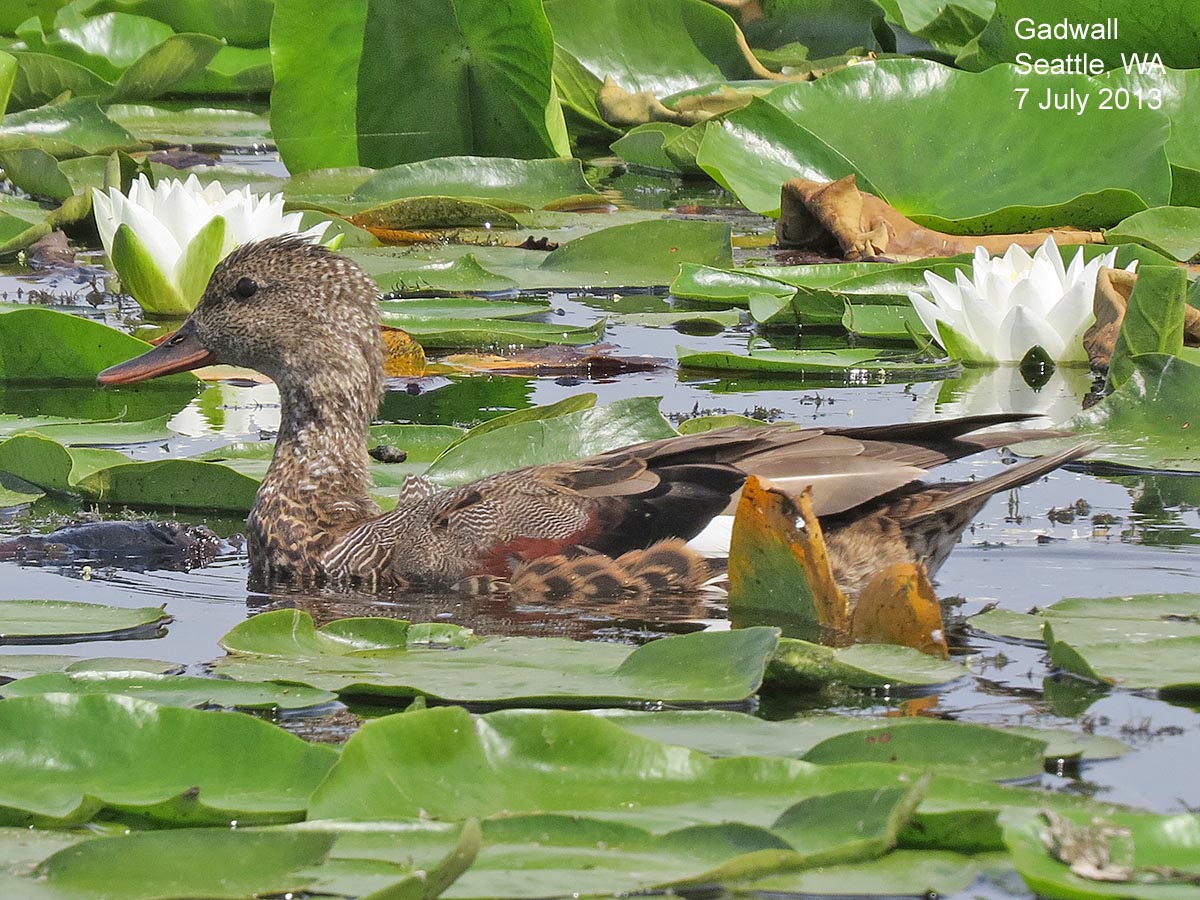
This just might be the spring song at the top of the Coyote Hit Parade. Ducks have been breeding for the past several months in the Pacific Northwest, and there is a steady supply of cute, fuzzy, edible ducklings. Mallards were first, and many of them have full-sized young now. They were followed by other species, including Gadwalls, the second most common breeding duck in western Washington.

Ducks lay clutches of around 8-10 eggs and incubate them for almost a month to hatching. Incubation begins when the last egg is laid, so the young all develop synchronously and hatch at about the same time. The female leads the ducklings from the nest off to a good wetland feeding area, watching carefully for predators.

She can warn her offspring to hide, but she can’t do much to protect them against the predatory mammals, birds, snakes, frogs and fish that might relish a duckling meal. A duckling might be a snack for a Coyote, a good lunch for a Mink, or an overstuffed belly for a Bullfrog.

The downy (cute) stage in a Mallard lasts about 25 days, and then they begin feathering out and enter their gawky “teenager” stage.  After another few weeks, they are fully feathered, and they can fly at around two months of age; most broods are abandoned by the female then or a bit before.

Males of most species of ducks desert their mates when incubation begins, but in city ducks, it seems that more and more males can be seen with their families, at least early in the season, and one wonders if there are genetic changes happening in these populations.


The males begin to molt out of their definitive plumage soon after leaving the females, changing to a female-like eclipse plumage and eventually molting all their flight feathers simultaneously. The Gadwall shown here is entering that plumage. After their brood has fledged, females also undergo a complete molt, although they don’t change plumage.

Meanwhile, predators are taking their toll. Rarely will you see a complete brood of ducklings. Instead, the numbers decrease week by week until there are often only a few left with any given female. Sometimes females combine broods, raising the level of predator awareness with two pairs of eyes, but the young still remain relatively unprotected.

In any case, all a pair has to do is raise two young successfully in their lifetimes to keep populations stable. Waterfowl populations as a whole are doing well, so those females must be doing something right! Perhaps it’s good that not all those ducklings survive, as wouldn’t we be knee-deep in ducks at some point?

Dennis Paulson

Tuesday, April 9, 2013

A HERONRY TO WATCH


I recently learned of a Great Blue Heron nesting colony in Kenmore, Washington, only 10 minutes from my house. But the colony, at the edge of a park and ride lot, was at some distance from the vantage point, so it would take a long telephoto to get good photos of them. So I went up there with my new Canon PowerShot SX50 HS camera with its 50x zoom lens.

The colony has about 50 obvious nests, although not that many pairs were present during my two morning visits. Activity levels were low, consisting mostly of birds flying out to gather additional nesting material. But that activity had birds flying in with twigs and branches often enough to be photogenic, and a few birds even landed in the nearby Douglas-firs to tug on live branches. Otherwise the herons stood quietly at their nests.

The nests are reused for many years, birds sometimes changing nests between years. I don't know what happens when a bird chooses a nest and its previous owner returns soon thereafter! You do see sparring in the colonies.

Males procure the nest material and females remain at the nest to put it in place, and I saw numerous such exchanges. The sexes can't be distinguished, so all one can do is make assumptions that are supported by previous research. The first eggs should be laid in March, according to the literature, so presumably in early April some of the birds had clutches already. Indeed, some birds were flat on the nest, presumably incubating.

Copulation takes place both before and during egg laying, and one such act was observed during a two-hour visit. Both sexes incubate, alternating during the 24-hour period (females more at night), and the total incubation period is about 27 days. Hatching is asynchonous, as incubation begins when the first egg is laid, so the youngest bird may be several days younger than the oldest.

Once the eggs hatch, the young remain in the nest 7-8 weeks, so there will be plenty of photo opportunities to come. One thing I will be looking for is siblicide, where a young bird attacks and actually kills a nestmate. The prey is often dropped into the nest in the midst of the young, and especially when the items are small, the young are more likely to fight over them. When food is limited, it makes evolutionary sense for the brood to be reduced, so the remaining young will have sufficient food to grow and fledge.

Great Blue Herons have had a hard time of it in the Seattle area, as Bald Eagles, which have increased tremendously in recent years, visit their colonies as they are forming and take eggs, young or adults if they can catch them. A few such disturbances will usually cause the adults to desert the colony. They can either move elsewhere or just fail to breed. The next season they try again at another spot, and there is a fair likelihood that eagles will find that spot as well.

I keep hoping that the eagles won't destroy this colony. It has been established for a decade at least, so there is hope. On occasion, herons nest very near an eagle nest, and apparently that keeps other eagles away from the heron colony. I don't know why the resident eagle doesn't take its toll.

Dennis Paulson

Tuesday, January 8, 2013

SHRIKES, SONGBIRDS OF PREY


We are all familiar with hawks and owls, raptorial birds with strong feet and long, curved talons for capturing and carrying prey and a strong, sharp-edged, hooked bill for tearing that prey into bite-sized morsels.

But there is another group of common birds that are just as predatory, although with somewhat different anatomy. These are the shrikes. Shrikes are members of the perching bird order Passeriformes, and although that order is full of insect eaters (shrikes do this), it's not so full of birds that eat small vertebrates such as lizards, songbirds and rodents (shrikes do this too).

Loggerhead Shrikes (Lanius ludovicianus) are widespread breeders in interior sagebrush habitats in the Pacific Northwest. With us only in the summer, they feed primarily on large insects such as grasshoppers and beetles, but they also eat small vertebrates whenever they can capture them, including voles and birds right up to their own size.

Northern Shrikes (Lanius excubitor) breed in the boreal forest and drop down to the PNW in the winter. They are more widespread than Loggerheads, occurring throughout the region in open country. Although they take many insects on their breeding grounds, Northerns are bird and mammal eaters in the winter. Voles are among their most common prey, but they will chase and capture small birds of any sort.

Shrikes have typical perching-bird feet, not raptorial, and they don't capture or kill their prey with their feet, but they do use their feet to carry prey, especially heavy items and even up to their own weight; otherwise prey is carried in their bill.

Although not just like a hawk's, the bill is strong and hooked at the end. It has a pair of toothlike structures near the tip of the upper mandible (tomial teeth) that are important in prey-killing. The shrike bites a vertebrate just behind the head, and the "teeth" apparently sever or injure the spinal cord sufficiently to kill or paralyze the prey, which then cannot struggle and possibly injure the predator.

Not having feet to hold a prey animal down while tearing pieces of flesh off, shrikes have evolved a substitute. They carry their prey to something on which they can position it. In nature, this would involve impaling on thorns or hanging from crotches where two branches diverge. They can then begin to dismember the prey.

Having evolved this behavior and often taking prey much too large to be eaten in one session, shrikes further evolved the behavior of leaving the prey hanging and returning later to eat some more. Wherever shrikes occur, such prey are liable to be found. Nowadays, we can watch for shrike prey caches on barbed-wire fences!

Dennis Paulson

Tuesday, November 13, 2012

BALD EAGLE - HERO OR VILLAIN?


The Bald Eagle is the national symbol of the United States of America. It seems appropriate for a country to have such a majestic bird as a symbol. Long-lived, monogamous, good parent, characteristic of wild places, Bald Eagles excite awe and admiration wherever they fly.

There have been notable dissenters from this view, including Ben Franklin, in a letter to his daughter 20 June 1782: "For my own part I wish the Bald Eagle had not been chosen the Representative of our Country. He is a Bird of bad moral Character. He does not get his Living honestly. You may have seen him perched on some dead Tree near the River, where, too lazy to fish for himself, he watches the Labour of the Fishing Hawk; and when that diligent Bird has at length taken a Fish, and is bearing it to his Nest for the Support of his Mate and young Ones, the Bald Eagle pursues him and takes it from him."

Yes, Bald Eagles are inveterate kleptoparasites, robbing Ospreys and other raptors of their prey. Like all birds, they have terrific vision and are aware of what goes on all around them, even at some distance. Not even a swift and strong Peregrine Falcon can withstand the attack of an eagle determined to wrest a recently captured bird from it.

In the middle of the 20th Century, Bald Eagle populations were decimated by ingesting DDT along with the fish and fish-eating birds that they preyed on. DDT compromises calcium transport, and the eggs laid by the eagles, with inadequate calcium, were thin-shelled enough to crack under the weight of an incubating female. Reproductive success fell and populations declined along with it.

DDT was banned in the US in 1972, and eagle populations have been rebounding ever since, to levels greater than any previously documented. Their numbers have skyrocketed in particular in the Pacific Northwest, which must be optimal eagle country.

Unfortunately, the consequences of this are dire for some other bird species. Eagles are opportunists above all, and they have learned to make a living, at least in spring and summer, by hanging around bird colonies. With present eagle numbers, colonies of Great Blue Herons, Caspian Terns, and Common Murres on and near the coasts have been hit hard by these predators, sometimes just single birds taking advantage of the prey concentration.

The nesting birds have no way to withstand eagle predation, losing eggs, young and even adults to the predators. Even though eagles may eat a small percentage of the birds in a colony, their presence causes nesting to be disrupted to the point of complete colony abandonment. Because of this, numerous Great Blue Heron colonies have failed, and even huge colonies of thousands of murres and terns have been abandoned.

In the coming years, wildlife managers will have to figure out how to deal with this dilemma. Bald Eagles are not on the endangered species list any more, but they are still protected. The birds whose colonies they are destroying are also protected and of concern, and what should we do when one valued species affects another one so severely?

Dennis Paulson

Tuesday, April 3, 2012

SNOWY OWLS ARE ORNITHOPHAGOUS!


The Snowy Owls (Bubo scandiacus) that came down to Washington this winter, which I have written about before, finally contributed some pellets to the cause of science.

Of course, you know what owl pellets are. Birds of prey, and actually quite a few other birds, eat a lot of stuff that doesn't make it through their digestive tract. Hair and feathers are difficult to digest, as are bones and mollusk shells. So even if they are broken into smaller pieces when eaten and crushed by heavily muscled gizzards, even the smaller pieces can't pass through the hindgut very well. Rather than sharp-pointed bones coming up one by one, they are coated in hair or feathers and barfed, urped, hurled, vomited and/or regurgitated back into the environment.

It's not easy to find these pellets unless you know right where the bird has been roosting. After they are produced, they get covered up by detritus, even blown around, and eventually decay into pieces. But they hold together for a while, and ornithologists have long used them to get a handle on the diet of birds such as hawks and, especially, owls. Snowy Owl pellets look like fuzzy three-inch cigars. It's been said there is nothing like a good cigar, but I personally prefer owl pellets.

Paul Bannick, well-known bird photographer and author of The Owl and the Woodpecker, recently sent me three pellets he picked up from one spot at Ocean Shores. At the museum, we soaked them in water and stirred them up until the feathers floated and the bones sank. We recovered a surprising amount of bones, arranged them by type, and identified them by comparing with our skeleton collection.

I had a pretty good idea what birds were out there, and it wasn't difficult to identify the majority of the bones as sandpiper bones. The only confusion would have been between Sanderling and Dunlin, both common birds in Grays Harbor. Sanderlings were common right where the owls were roosting, so I favored them. Sure enough, there were several lower mandibles present, and they clearly belonged to Sanderlings.

In total, at least five Sanderlings were present in these pellets, as indicated by counts of tibiae and tarsometatarsi, long, slender bones that were well represented because birds of prey tend to swallow legs of smaller birds whole. In addition to all the sandpiper bones, there were quite a number of larger bones. Many of them were broken up, but a few were intact, and two coracoids and a femur allowed identification as a Horned Grebe. Probably all the bones, including many vertebrae, were from the same bird.

I also examined single pellets from Sandy Point, near Bellingham, furnished by Isa Werny and Andrea Warner. They were mostly feathers, but one of them contained a few Horned Grebe bones, the other a few Bufflehead bones. The second pellet was found at the foot of a utility pole along with parts of a dead Bufflehead, making the identification easier. Both of these species are known Snowy Owl prey.

Snowy Owls are well known to subsist largely on water birds in the winter on our coast, and there wasn't a trace of a mammal in these five pellets. By now you may have figured out that ornithophagous = bird eating.

Dennis Paulson

Tuesday, September 20, 2011

TIGERS OF THE SAND

Go to a sandy beach or an open patch of sandy soil just about anywhere in the summer and you are likely to see tiger beetles. You will at first see these diurnal insects running ahead of you. Their long, slender legs propel them over the ground at amazing speeds. If you get too close, they jump into the air, open their elytra (wing covers), and quickly fly away. They usually land nearby, and you may be able to follow individual beetles until one lets you get close enough for prolonged observation.

But look quickly, as they are likely to run and stop, run and stop as they hunt for prey. They have exceptionally long, sharply pointed, tooth-lined mandibles, with which they capture other insects and spiders. They make short work of their prey and move on to hunt again. Their vision is superb, both to find prey and avoid predators.

Even though they are alert and fast, they do have predators, including birds, lizards, and robber flies. Birds such as kestrels and flycatchers capture them in the air, shrikes on the ground. As well as their obvious adaptations, some tiger beetles secrete defensive chemicals that presumably protect them from some predators.

The cuticle of tiger beetles is somewhat iridescent, and although the majority of species are sort of a bronzy brown, many of them are brightly colored, usually green but sometimes purple or blue. Some species are polymorphic, coming in two or more of these colors. The undersides are often more metallic than the upper surfaces. Some species have red abdomens that show up when they fly. Most tiger beetles have a characteristic pattern of spots and lines on their elytra, and variations on that pattern are often what define different species.

Unlike many insects, when tiger beetles mate they both face the same way, so they can continue to run across the ground (but not to fly) when the male is perched on the female's back. This lessens the likelihood of predation when they are in this vulnerable state. A male may remain on the female's back after copulation to keep other males from mating with her. Females lay their eggs, one at a time, into the soil in places appropriate for the larva.


Tiger beetle larvae are just as predacious as the adults, but we don't see them at work. They live in burrows in the sand, covered except for a hard head capsule and a pair of mandibles. When another insect comes too close, they reach up from the surface and grab it, then pull it down into their burrow, to which they are anchored by hooks on top of the fifth abdominal segment. They have been known to capture dragonflies of much larger size that had the bad luck to land right at the mouth of a burrow.


There are 17 species of tiger beetles known from Washington state, all in the day-active, brightly colored genus Cicindela except for two nocturnal black species of Omus. Few of the species are statewide; most have limited ranges on one side of the Cascades, up in the mountains, or along the coast or big rivers.

Fortunately for aficionados of this group, there are two fine books available:

A Field Guide to the Tiger Beetles of the United States and Canada, by David L. Pearson, C. Barry Knisley, and Charles J. Kazilek, Oxford University Press, 2006.

Tiger Beetles: The Evolution, Ecology, and Diversity of the Cicindelids, by David L. Pearson and Alfried P. Vogler, Cornell University Press, 2001.

Dennis Paulson

Nature Blog Network